
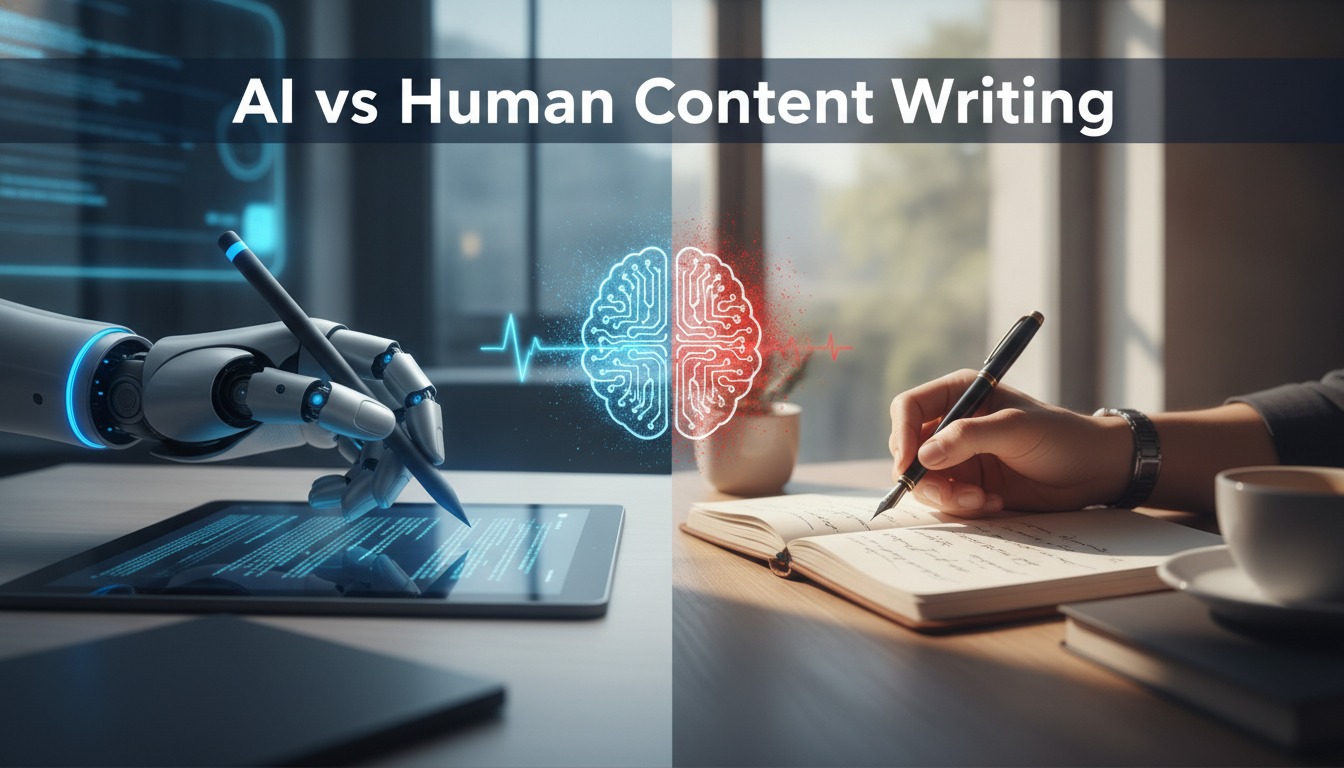

Content teams hit the same wall every quarter with AI vs human content writing choices. When calendars fill and budgets shrink.
Hard to ignore those numbers. The pressure builds fast; Google judges E-E-A-T quality the same way no matter the source, yet fake facts and flat voice still sink rankings.
That conflict is exactly where most campaigns stall.
- Generative tools cut production time by over 50% and drop draft costs below ten cents per thousand words with mandatory fact checks.
- Human writers alone deliver original stories, interviews, and brand voice that pure models cannot copy or invent.
- Hybrid pipelines that use AI for outlines then human edits return the strongest ROI for SEO scale without quality collapse.
Key Point
- Google Search Central states quality matters more than the production method for ranking signals.
- Many marketers find fixing weak AI drafts often takes longer than drafting from a blank page themselves.
- Clients now push for human-only guarantees on premium thought leadership pieces to protect trust.
- Real life experiences and primary interviews remain human-only strengths that models still miss.
Table of Contents
- What Is AI vs Human Content Writing?
- Speed Cost and Quality Gaps Explained
- Hybrid Reality and Common Mistakes
What Is AI vs Human Content Writing?
AI vs human content writing compares machine-generated text that predicts patterns from training data against writing created by people who live experiences, interview sources, and shape distinct voices.
At a high level, the core fight centers on trade-offs. Models like those behind ChatGPT or Claude turn research into readable copy in minutes. People still supply the lived detail and original judgment. Where does that leave us? Who would have thought? Pure AI output often hallucinates citations with high confidence.
While human work stays grounded. Clean and simple. When I pulled side-by-side samples for a client campaign, the machine drafts looked polished at first glance. Yet repeated the same stiff transitions. And empty phrases (which make perfect logical sense) writers on forums constantly flag.
The bottom line: machines accelerate volume — well. While most of us protect meaning and emotional pull.
Why does this comparison matter for marketers right now?
Marketers need both scale and trust. Because search engines reward E-E-A-T without caring about the writer type, so platforms raise writing speed and fluency by over 50 percent according to productivity studies.
Yet Harvard Business Review notes they still cannot pull off the hard thinking. The follow-up question is obvious. Brands that ignore the gap flood sites — or at least, with generic pages that rarely ever stand out.
Speed Cost and Quality Gaps Explained
AI finishes a thousand words in 1 to 3 minutes at API costs under $0.10-20, while human professionals need 3 to 5 hours and charge $50 to $300 for the same length, shifting the real choice to risk versus connection.
In most scenarios. Here is the practical split I keep seeing. Near-instant turnaround lets teams fill calendars that once stretched for weeks. Cost drops to pennies for outlines and first drafts. But the prose turns repetitive.
Fails to break through crowded search results. Fact-checks become mandatory because no LLM models can verify their own claims — humans bring genuine emotion, personal storytelling, and primary research that build brand memory.
Production stays limited by personnel capacity, which blocks rapid scaling.
| Attribute | AI | Human |
|---|---|---|
| Cost per 1,000 words | Less than $0.10-20 | $50 to $300 |
| Production speed | 1 to 3 minutes | 3 to 5 hours |
| Fact-check need | Mandatory high risk | Recommended low risk |
| Best use | Drafts and outlines | Thought leadership SEO |
What catches teams off guard with pure AI drafts?
The catch is editing time. Plus, many marketers report that polishing weak machine text regularly lasts longer than writing the piece fresh. Clichés pile up, and voice disappears. Direct AI generated content versus human samples make the pattern obvious once you look for it.
Our focus on the quality of content, rather than how content is produced, is a useful guide for us to deliver high-quality results.
Realistically, going back a bit, that Google Search Central line settles the debate over ranking. Still, how AI reshapes writing workflows keeps evolving faster than most style guides.
Hybrid Reality and Common Mistakes
The hybrid model that assigns AI the outline research and rough draft, then hands editing and personality to humans, currently delivers the best return because pure options leave money or trust on the table.
When I ran this split last quarter, the difference showed up in client feedback within days; machines handle the skeleton while people inject the lived moments and unique tone that stick. Wait, that’s not quite complete. The real edge comes from treating AI as an assistant that never ships alone.
A common failure is treasuring speed so much that you skip the human pass — which is why you end up with pages nobody remembers. Another quiet mistake is budgeting zero time for verification.
Which turns confident false statements into live site problems.
Generative AI can help us write faster and more fluently, but it cannot do the hard work of thinking for us.
The Harvard Business Review line nails the boundary. Now flip that around. Scale with platforms. Protect thinking with people.
- Map content types — Label each piece as scale draft or thought leadership before choosing the process.
- Run AI outlines only — Generate structure and notes then stop so humans own the voice layer.
- Require triple fact checks — Verify every claim against primary sources before any publish button.
- Audit brand voice monthly — Compare finished pieces to pure human samples and adjust the edit checklist.
People Also Ask
Can Google detect and penalize AI content?
Google doesn’t penalize based on production method, and it ranks pages by E-E-A-T quality signals regardless of AI or human origin. Low-value or inaccurate material loses visibility either way. So the shield remains rigorous editing and real expertise.
Is pure human writing still worth the higher cost?
This reflects what I mentioned a while ago. Now, yes for premium expertship and brand-defining work. Original interviews and emotional narratives still justify $50 to $300 rates. When trust drives conversion. Commodity pages justify hybrid or lighter AI support.
How much faster is AI really for content teams?
Generative tools raise productivity by over 50 percent. And cut turnaround from days to minutes. And honestly, supervision remains non-negotiable, given hallucinations. And repeated phrasing appears without human review.
Should freelancers switch fully to AI assistance?
The underlying point remains simple. No. It’s worth noting that the freelancers who thrive treat AI as research. Think it through and outline the partner while protecting their unique viewpoint and interview skills. A full switch erodes the human edge clients pay for.
Final Verdict on AI vs Human Content Writing
The decision is no longer binary. Speed and tiny costs belong to machines.
Connection goes through, and original insight stays human. Yet, hybrid pipelines that respect both sides win the actual traffic and trust race, so keep measuring quality first.
More data needed. Keep learning how the tools evolve. Test a hybrid draft process on your next three posts and track the difference in both output volume and engagement. That single experiment reveals more than any abstract debate.



