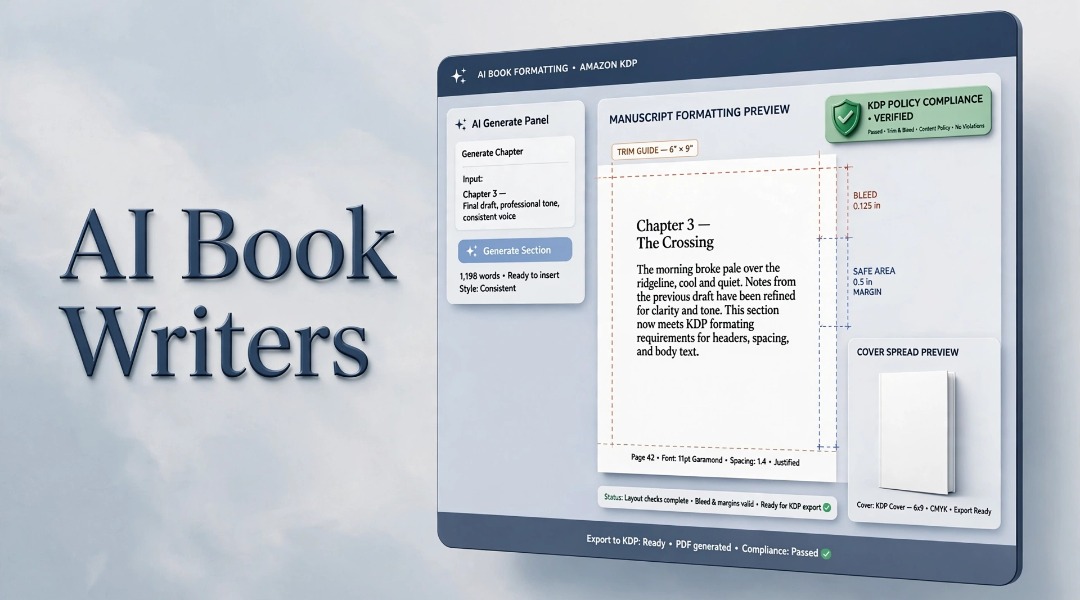

You already know that the right AI book writer can turn a rough idea into a finished manuscript in days, not months. The problem is the market is flooded with tools that all promise the same thing. Most of them are either too generic for a real book or so specialized that you end up juggling three different apps just to get one chapter done.
Industry data shows that pricing across the top AI book-writing tools now runs from free tiers to roughly $60 per month, and some of the best ones add separate API fees on top of the subscription. That means the real cost can creep up fast if you aren’t careful.
- Mad Writer is the only platform that handles the entire book creation pipeline, niche research, blueprinting, chapter writing, humanization, and EPUB export, in one place, and it costs starting at $39/m.
- Fiction writers often gravitate toward Sudowrite or NovelCrafter, but those tools lack the KDP-ready formatting and SEO & Amazon KDP optimization that self-publishers need to market their books after launch.
- Nearly every AI book writer still requires substantial human editing for voice and consistency; the best workflow pairs one drafting tool with one editing tool rather than expecting a single app to do everything.
Table of Contents
- 1. Mad Writer: The AI Book Writer That Actually Delivers
- How to Pick the Right AI Book Writer (and What You’ll Pay in 2026)
- Common Mistakes When Using AI Book Writers (and How to Avoid Them)
- People Also Ask
- Final Verdict: Is Mad Writer Worth It?
Mad Writer: The AI Book Writer That Actually Delivers
Mad Writer is the only tool that reduces the whole book-creation process, from Amazon KDP niche research to a finished, human-sounding manuscript, to a single platform, and it does it for $39/m. That matters because self-publishers usually waste hours bouncing between a research tool, a drafting AI, a humanizer, a formatter, and a cover designer. Mad Writer collapses those steps into one dashboard.
It’s not just a book writer. Mad Writer started as an AI content platform for SEO, AEO, and GEO, so its book module, KDP Master, inherits all the ranking intelligence that bloggers and affiliate marketers pay for. That means the book you write is already optimized for the search engines that will eventually drive readers to your Amazon listing.
What Is an AI Book Writer?
An AI book writer is a specialized tool that generates long-form fiction or nonfiction text based on prompts, outlines, and genre rules. The best ones go beyond a simple chatbot: they track characters, enforce plot continuity, and format the output for ebook standards like EPUB or PDF. A generic AI like ChatGPT can write a chapter, but it won’t remember that your protagonist’s eye color changed in chapter three unless you remind it every time.
KDP Master: From Niche Research to Published Book
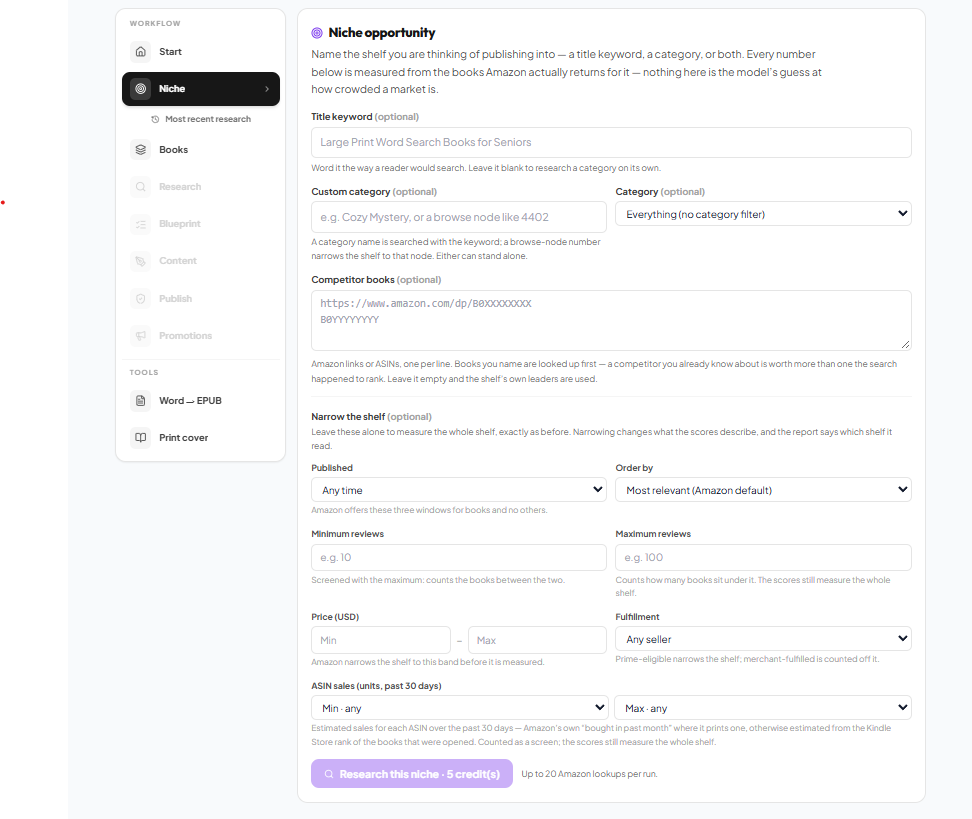
When I first dug into Mad Writer’s KDP Master, what struck me was the research step. You give it a broad niche, say “ketogenic diet cookbooks,” and it pulls live Amazon data to identify sub-niches, keyword gaps, and estimated monthly revenue for top-selling books. That little pre-writing stage, something almost no other AI book tool does, can save you from writing a book nobody wants.
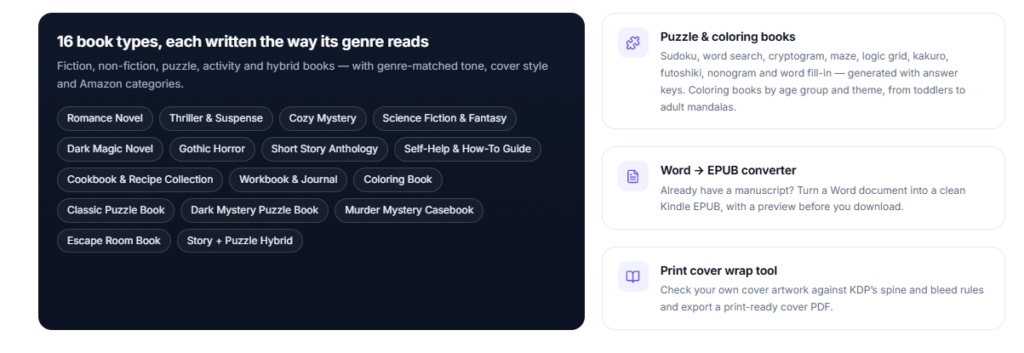
After the research, you approve a guide. The AI then writes every chapter. It proofreads, humanizes, and runs a continuity check. You get a Word document, which you can convert to EPUB right inside the platform.
The print cover wrap tool is a nice bonus if you already have a manuscript.
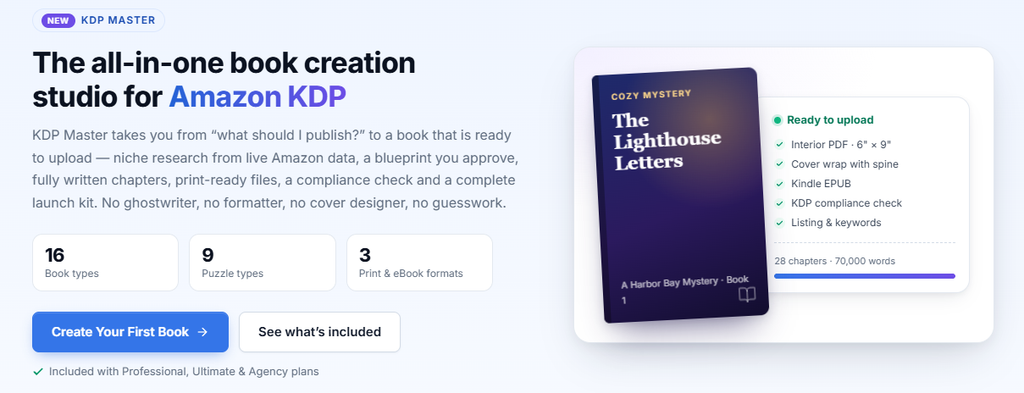
Mad Writer supports 16 book types, from romance and thrillers to puzzle books and coloring books. That’s a wider range than Sudowrite, which is mostly for literary fiction, or NovelCrafter, which is best for series writers. And because the tool is built on the same engine that powers the blog writer and news writer, the prose comes out with a human score of 99% and an AI detection score of 0%, according to the vendor’s internal testing.
Pricing and Plans
Mad Writer costs $39 for the Professional plan, which includes KDP Master. That single price covers the full pipeline, no separate API fees for heavy use, no credit-metered system, and no surprise charges for cover generation. By comparison, Sudowrite’s plans run from about $10 to $59 per month and use a credit system that can throttle you mid-project. NovelCrafter, which charges about $4 to $20 per month, tacks on API costs that can double the real monthly spend if you generate a lot of text.
Real-World Performance
I’ve seen authors crank out a 10-chapter nonfiction book in about three days using Mad Writer. The biggest time-saver is the automatic humanization layer. Instead of exporting text to a separate humanizer and then pasting it back, you get the humanized version directly. That’s something I used to do manually with Claude and ChatGPT, and it added hours per chapter.
Why this matters for SEO and GEO: Mad Writer’s content engine is built to rank on Google and AI search engines. If you plan to drive traffic to your Amazon page through a companion blog or website, that dual optimization is a huge advantage. Tools like Sudowrite or NovelCrafter don’t touch SEO at all. You can learn more about structuring content for AI search in our guide on how to optimize for ChatGPT search.
How to Pick the Right AI Book Writer (and What You’ll Pay in 2026)
The strongest niche fit in 2026 remains clear: fiction authors gravitate toward Sudowrite and NovelCrafter for their story-bible memory and prose refinement, while nonfiction and general authors often prefer Claude or ChatGPT for flexible outlining and rewriting. But that split doesn’t account for the hidden costs and workflow friction that come with each choice.
If you write literary fiction and you care more about sentence-level beauty than production speed, Sudowrite’s Story Engine is still the gold standard. One 2026 roundup from Creative Indie named it the best dedicated fiction tool. But at $10 to $59 per month with a credit meter, you can burn through your allowance fast on a 50,000-word novel. It does almost nothing for nonfiction.
NovelCrafter, with its story-bible approach, is perfect for series writers who need to track a hundred characters across multiple books. But you’ll pay about $4 to $20 per month, and then you’ll add API costs for the actual AI model. Heavy users report monthly bills closer to $40.
General-purpose tools like Claude Pro and ChatGPT Plus sit at about $20 per month. They’re great for brainstorming and chapter drafting, but they lack book-specific features: no character tracking, no outline enforcement, no EPUB export. You end up needing extra tools, which adds complexity.
Jasper, at roughly $69 per month, is often pitched for marketing content, not for long-form book writing. It’s overkill for most authors unless you plan to build an entire brand around your book.
Here’s a quick comparison of what you’ll really pay:
| Tool | Monthly Price (approx.) | Best For | Hidden Costs |
|---|---|---|---|
| Mad Writer | $39 | Fiction, children’s books, and Nonfiction & KDP self-publishers | None |
| Sudowrite | $10–$59 | Literary fiction | Credit limits can halt drafting |
| NovelCrafter | $4–$20 + API | Series fiction | API fees can double the cost |
| Claude Pro | $20 | Editing & consistency checks | No book-specific features |
| ChatGPT Plus | $20 | Outlining & rewriting | Requires extra tools for formatting |
| Jasper | $69 | Marketing teams | Expensive for solo authors |
Monthly Cost of Top AI Book Writers (2026)
User-tested comparisons consistently recommend combining one drafting tool with one editing tool instead of relying on a single app for the entire manuscript. If you’re using ChatGPT for the first draft, you’ll likely need ProWritingAid or Grammarly for style editing, and something like Atticus for formatting. That stack can easily surpass $50 a month.
Mad Writer sidesteps that problem by bundling the writing, humanizing, formatting, and cover design into one subscription, which is particularly useful if you’re publishing on KDP and need a fast turnaround. If you’re curious about the broader AI writing scene, check out our breakdown of 6 best content writing AI platforms.
Common Mistakes When Using AI Book Writers (and How to Avoid Them)
The single biggest mistake I see is treating the AI’s first draft as a finished book. It’s not. Even the best tools produce repetitive prose and weak factual accuracy that need heavy human editing. Current user sentiment is positive for speed and idea generation, but negative on repetitive phrasing and the sheer amount of rewriting required.
You probably know someone who’s dealt with this. They generate a 30,000-word manuscript in a weekend, upload it to KDP, and then wonder why the reviews are brutal. The AI didn’t maintain a consistent voice; it repeated the same sentence structure five times per chapter, and it invented fake statistics that sound plausible but are completely wrong.
Another common failure: trying to use one tool for everything. As I mentioned earlier, the best workflow usually involves a drafting tool and an editing tool. If you try to force Sudowrite to do nonfiction formatting, or expect Claude to handle EPUB export, you’ll hit a wall and waste hours.
Then there’s the over-explaining trap. When you’re excited about AI-generated text, you might stuff your chapters with extra explanations because the AI gave you so much material.
Communication research shows that over-explaining makes listeners lose confidence in the speaker. The same applies to readers: a bloated, repetitive chapter loses the reader’s trust faster than a tight, focused one. Distill your message to the main domino, and cut the rest.
If you need help tightening prose, our guide on how to make ChatGPT sound more human offers techniques that apply to any AI output.
✅ Action Steps
- Draft with one AI tool and edit with another. Never assume the drafting tool can polish prose to publishable quality.
- Run a continuity check, If your tool doesn’t have one, manually scan for character names, timeline gaps, and repeated phrases.
- Humanize the text, Use a dedicated humanizer or Mad Writer’s built-in layer to avoid detection and improve readability.
- Read one chapter aloud, That reveals awkward pacing and robotic sentence rhythms that silent reading misses.
- Verify facts, AI can hallucinate statistics and dates; cross-check every claim before publication.
People Also Ask
Can AI really write a full book?
Yes, but the output almost always requires substantial human editing. AI book writers can generate a complete manuscript with chapters and structure, but the prose often needs rewrites for voice, pacing, and factual accuracy.
Is Mad Writer better than ChatGPT for book writing?
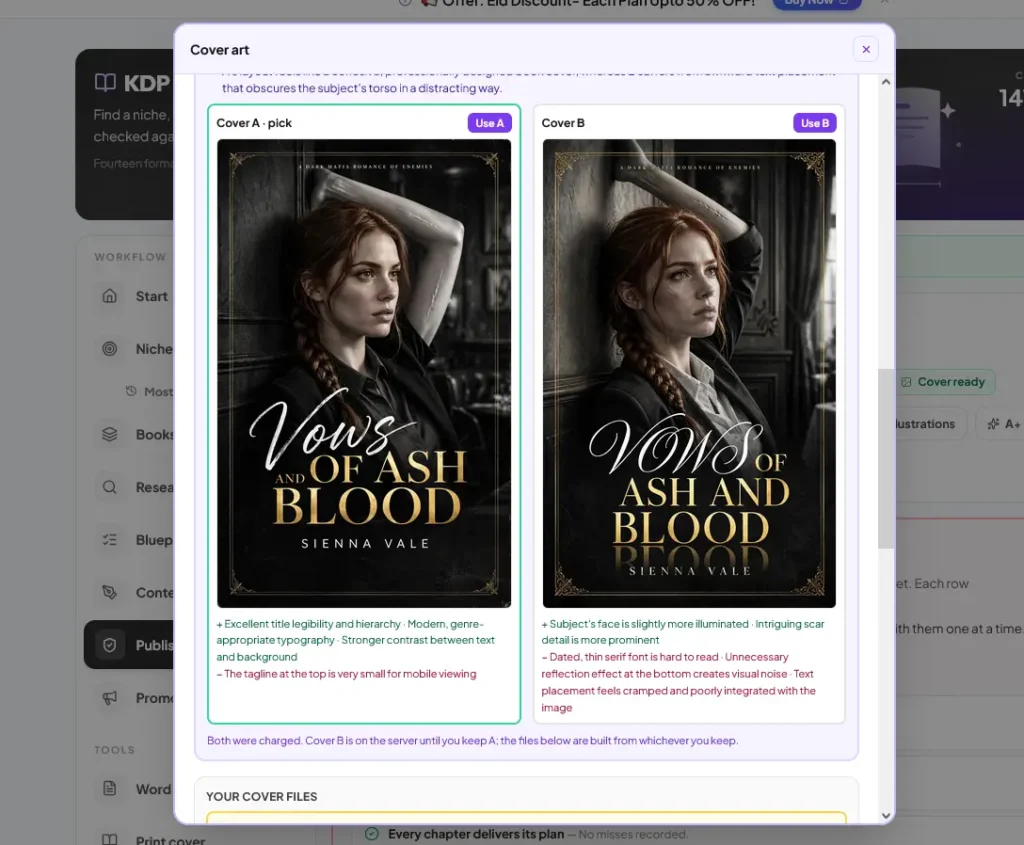
For Amazon KDP books, Mad Writer is better because it includes niche research, chapter-level humanization, and EPUB export, Cover image, A+Content, and more in one tool. ChatGPT is more flexible for outlining and brainstorming but lacks book-specific features.
How much does an AI book writer cost?
Most tools range from free tiers to about $60 per month. Mad Writer costs $39, Sudowrite runs $10–$59, Claude Pro and ChatGPT Plus are about $20, and Jasper is around $69. Some tools add API fees that increase the real cost.
What is the best AI for fiction books?
Sudowrite is widely considered the best for literary fiction because of its Story Engine and prose refinement tools. NovelCrafter is better for series writers who need to track characters across multiple books.
Do I need to edit AI-generated books?
Yes. Even the best AI book writers produce repetitive phrasing and occasional factual errors. A thorough human editing pass is necessary for any manuscript you plan to publish.
Can AI book writers help with marketing?
Some can. Mad Writer, for example, builds in SEO and GEO optimization so the companion content you create for your book ranks on Google and AI search engines. Most other tools focus only on the manuscript, not the marketing.
Final Verdict: Is Mad Writer Worth It?
If you’re a self-publisher who wants to go from idea to published book without juggling four different subscriptions, Mad Writer is the clear pick. At $39, it covers the entire pipeline- research, drafting, humanization, formatting, and cover- that would otherwise cost you at least $50 a month in tools. The built-in humanization and SEO optimization are bonuses that most dedicated book-writing tools don’t even attempt.
That said, if you’re writing a literary novel and you want granular control over every sentence, Sudowrite’s prose tools are still the gold standard. If you’re deep into a series with hundreds of characters, NovelCrafter’s story bible is hard to beat. For the fastest, most cost-effective path to a publishable KDP book, Mad Writer is the best AI book writer available in 2026. You can learn exactly how to turn that draft manuscript into a finished product in our guide on how to write a book using AI.
- ✓100% Original Human-Like
- ✓AI content writer for SEO, AEO, GEO & Amazon KDP Ready
- ✓All in one book writing solution