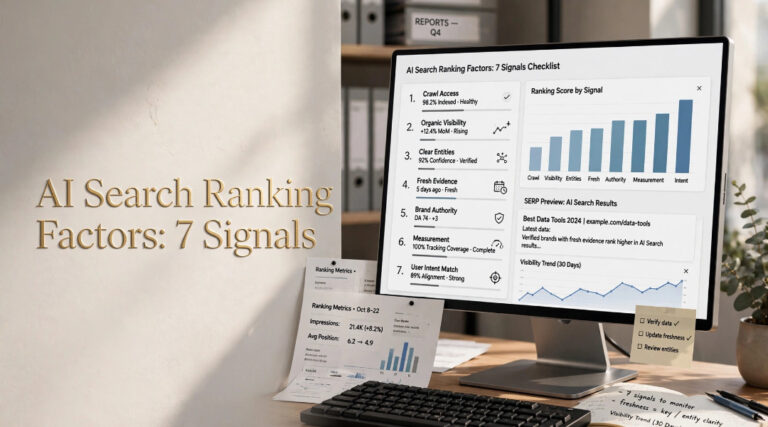

Is generative engine improvement the future of web marketing? Yes, but GEO won’t replace SEO.
It’ll become the layer that decides whether your brand appears inside answers from ChatGPT, Google AI Overviews, Perplexity, and Microsoft Copilot. That shift already affects planning: a Branch survey of 300 enterprise leaders found that 62% were improving crawlability for AI apps.
While 60% tracked AI citations and traffic. Skepticism is understandable; reporting still feels messy.
The mistake is waiting for perfect measurement instead of preparing.
Key Takeaways
- GEO is the next visibility layer.
- SEO remains the technical base, while GEO shapes citations, summaries, and brand mentions.
- FAQ formats, clear entities, structured data, and accessible pages give answer engines usable evidence.
- Treat AI citations as assisted discovery, not a replacement for sales and organic traffic reporting.
Table of Contents
- What Is Generative Engine Optimization?
- Why This Matters Now
- The Case for GEO as Marketing’s Next Layer
- What Critics Get Wrong
- People Also Ask
- What Should Happen Next
- FAQs

What Is Generative Engine Optimization?
Generative engine improvement is the practice of shaping content so AI answer systems can find, understand, trust, and cite it. It extends SEO through answer structure, entity clarity, technical access, and outside authority.
Classic SEO aims for a position on a results page; GEO aims for inclusion in the answer itself. The distinction matters, seeing as a system may read, or rather, several sources, combine them, and mention only a few brands. Ranking alone no longer guarantees that your company enters the conversation.
According to research by F. Rejón-Guardia and S. Molinillo, generative systems are being integrated into conventional search queries, creating new questions for marketing and publishing. For your team, that means content must work for both a crawler that ranks pages and a model that extracts evidence.
“To stay visible, brands need to structure content for AI parsing and retrieval.”
That advice sounds simple, but the work is technical. A page calls for clean headings, direct answers, useful schema, consistent company details, and links from trusted third-party sites. Mostly, a long article with buried answers forces retrieval systems to work harder, not to cite you more.
Enterprise AI-search tactics reported in survey (%)
Why This Matters Now
AI answers compress discovery into a short response, so brands that lack citations can lose attention even when their pages rank well. GEO matters now because enterprise marketers already spend time preparing for that change.
Search behavior has moved from ten blue links toward summaries, follow-up questions, and product recommendations. Readers may never visit every cited page. Which means a brand that appears in the answer earns recognition. Before the click, an absent brand must fight for attention later.
In most scenarios, according to a 2026 survey of enterprise leaders from Branch, 58% used FAQ or Q&A content for AI search, and 56% refreshed pages for AI summaries. Basically, those figures reveal a useful priority: answer design is becoming a regular editorial task, not a one-time technical fix.
How does GEO affect a normal SEO program?
GEO changes the output you measure, not the foundation you build. Keep technical SEO, links, useful content, and what users deal with. Then add tests for citations, mentions, and answer accuracy across AI platforms.
Switching focus for a then there’s this; this ties into what was mentioned before. A marketer should stop treating rankings as the only visibility report. Track whether ChatGPT, Google AI Overviews, Perplexity, and Copilot mention the brand for high-value questions.
Record the wording, cited sources, missing facts, and referral behavior. The report won’t be perfect, but it’ll expose gaps that rank tracking hides.
Going back a bit, a common snag is that your company page might say one thing. While review sites describe it differently. Models may repeat the outside version, and entity consistency across the website, Google Business Profile, product pages, and trusted directories reduces that risk.
The short answer isn’t more publishing; it’s better evidence.
The Case for GEO as Marketing’s Next Layer
GEO deserves a permanent place in online marketing because it protects discovery inside answer systems, improves content clarity, and connects brand authority with machine-readable evidence.
According to a 2026 systematic review by A. Rahman, AK MD, FU Mahmud, and KK Bishnu, generative AI is affecting content marketing, email campaigns, and SEO while raising consumer-trust concerns. The practical lesson is clear: speed alone won’t build durable visibility. Facts, disclosure, and review by subject experts matter more as machines summarize brand claims.
In most scenarios, according to M. Khan, S. R. J. Habibi, and M. S. Khan’s 2026 study, generative AI is changing consumer discovery and decision-making across internet-based marketing systems. Nine times out of ten, that supports a firm editorial view: marketers should improve the complete discovery path, from the first answer to the final product comparison.
What content earns citations most often?
Answer-led pages with clear entities and credible references give AI systems compact material they can extract without guessing. FAQ sections help, but they can’t rescue vague claims, weak sources, or blocked crawlers.
Start each page with a direct answer; then explain limits, give examples, and cite evidence; the contrast is clear.
Define SKUs without fail. Add fitting structured data, descriptive headings, author details, and dates for claims that change. Third-party reviews and expert mentions help seeing as an AI system can compare your claims with independent signals.
That’s where generative AI SEO best practices fit naturally. The techniques overlap with classic SEO. But the success test differs: can a system quote the answer accurately and attach your brand to it?
According to M. Pettiette, R. Conde, and S. Fischbach’s 2026 study, marketing education needs to address GEO as a new skill area. Teams should train writers, analysts, and technical SEOs together. So because citation problems often cross department lines.
“Optimising for generative AI search is optimising for the search experience, and so still SEO.”
The best strategy is hybrid. SEO builds access and authority. GEO turns that foundation into answer-ready material.
What Critics Get Wrong
Critics are right that GEO measurement remains immature, but they misread that weakness as proof the channel has no future. Similar uncertainty accompanied every new distribution system marketers adopted.
Recently, the strongest objection says GEO is recycled SEO with a new name. That criticism has teeth. Crawlability, entity clarity, useful writing, and authority already belong in good SEO practice. Paying for a glossy GEO audit that merely renames those tasks is wasteful.
Fine, the objection stops too soon. Plus, AI answers craft a distinct exposure point, with different outcomes and new failure modes. A page can rank, get few clicks, and still influence an answer through a citation.
The evidence is there. On the flip side, a brand can earn a mention that contains an outdated price, wrong feature, or confused product category.
Under normal conditions, according to A. Smith and J. Hutson’s 2024 research, marketing automation will continue expanding across SEO, email, and mobile applications. For strategists, the main point isn’t “publish more with AI.” It’s to build review controls before automated content reaches shoppers.
On a slightly different note, in practice, OpenAI, Google, Microsoft, and Perplexity can change retrieval or citation behavior without giving marketers a stable ranking formula. That makes GEO harder to forecast than classic search, and finance teams should measure assisted discovery, branded search, qualified visits, and conversions together.
According to H. Hasanuzzaman and M. S. Mollik’s 2027 strategic framework, GEO is emerging as a strategic capability in AI-era marketing communication. The date places the discussion beyond a short campaign trend. But the structure still points toward capability building instead of a magic checklist.
People Also Ask
Is GEO replacing SEO?
No. GEO extends SEO by adapting content for retrieval, answer extraction, citations, and brand mentions. Technical access, useful pages, and authority still support both systems.
Teams should add AI visibility checks instead of abandoning rankings, links, and site quality.
Is generative engine optimization the future of digital marketing?
Yes, GEO will become a lasting marketing layer because AI answers increasingly shape how people discover and compare brands. It won’t stand alone; SEO, brand trust, and conversion tracking remain necessary.
Can small businesses benefit from GEO?
Yes, small businesses can compete by answering narrow customer questions clearly and earning mentions from trusted local or industry sources.
They needn’t copy enterprise budgets. As it turns out, a focused service page, accurate business details, and useful FAQs can give a smaller brand evidence worth citing.
How should marketers measure GEO?
Measure prompt visibility, citation frequency, factual accuracy, branded search, referral visits, assisted conversions, and share of voice across selected platforms.
No single metric captures the full path, which means keep a baseline, test priority prompts, and separate exposure from revenue.
What Should Happen Next
Marketers should keep SEO as the base and add a measured GEO program now. Start with high-value questions, fix machine access, improve evidence, and review AI answers before competitors define the category.
The future question is settled, though the label may change. Is generative engine optimization the future of web marketing? Yes, as a working discipline, not as a replacement for sound search marketing. Teams that treat GEO as evidence management will build stronger visibility than teams that treat it as another content trick.
- Audit priority prompts; record how ChatGPT, Google AI Overviews, Perplexity, and Copilot describe your brand.
- Fix crawler access; check robots directives, rendering, internal links, and important pages that load poorly.
- Add answer structure; place direct responses, definitions, FAQs, schema, and source links near the relevant claims.
- Verify brand facts; compare your site with profiles, reviews, directories, and partner pages.
- Review results monthly; track citations, errors, referrals, branded demand, and assisted revenue beside normal SEO data.
FAQs
GEO usually needs better structure rather than a completely separate library. A strong SEO page can serve both goals. When it gives direct answers, clear entities, accessible text, and trustworthy supporting sources. The added work covers testing how answer systems retrieve and describe that page.
In most scenarios, ChatGPT, Google AI Overviews, Microsoft Copilot, and Perplexity are sensible starting points. Because they expose different answer and citation behaviors. Track the platforms your shoppers use, then keep a stable prompt set so month-to-month comparisons remain useful.
Going back to what was covered earlier, the biggest mistake is publishing shallow FAQ content and calling the work finished. Answer systems need accurate facts, strong context, crawlable pages, and outside confirmation. A short answer without evidence can produce a mention that misrepresents your brand.
Every company should prepare for AI discovery. But spending should match customer behavior and team capacity, so begin with a small prompt set and existing pages. Expand only when visibility data, referral patterns, or sales conversations show that AI answers influence demand.
“The playbook is clear: assess where you stand today, improve for AI retrieval, measure performance across platforms, then iterate nonstop.”