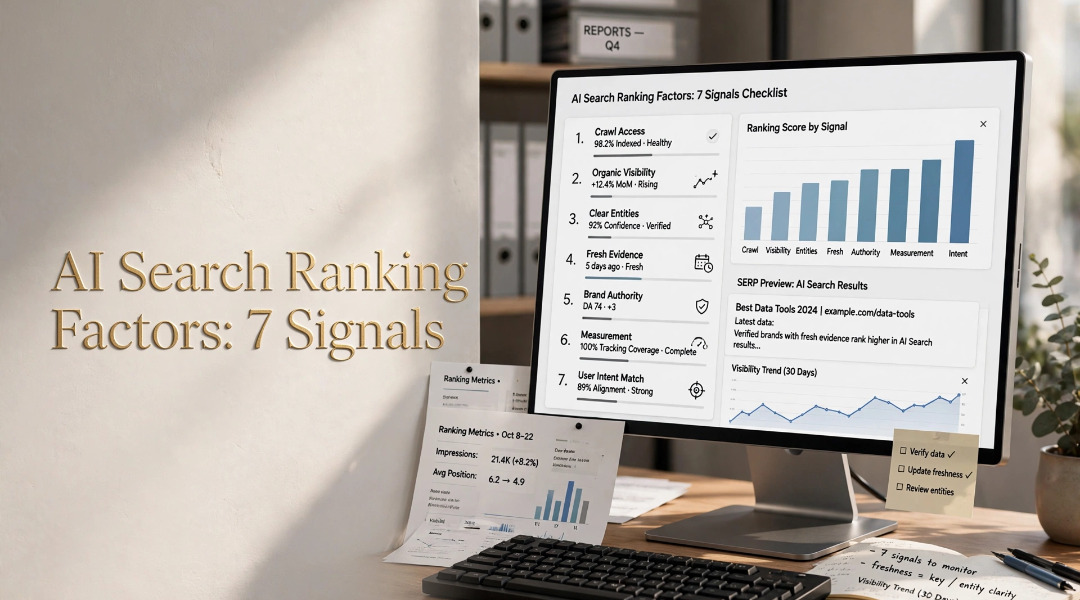

AI search ranking factors decide whether systems can find, interpret, and cite your pages; marketers face an uneven mix of signals. In an answer, a recent meta-analysis summary spots crawlability and indexability as the first gate across 54 studies; a page that search systems can’t access has little chance of appearing.
If you’re unsure whether established-school SEO still counts, it does, and organic search performance remains a strong correlate of AI inclusion. While each platform can weigh signals differently, this list moves from technical basics to authority and measurement. You can fix the highest-impact barriers first.
- Fix crawling first.
- Make each page answer one clear question, then support it with named sources, current facts, and a recognizable author.
- Brand trust is earned beyond your site.
Quick Summary
- Make pages crawlable and indexable before spending time on AI-specific copy edits.
- Give each page a direct answer, clear entities, and verifiable details that systems can extract.
- Support visibility with current information, strong organic performance, and trusted third-party references.
Table of Contents
- 1. Crawlability and indexability come first
- 2. Organic search performance still predicts inclusion
- 3. Clear entities make your subject unambiguous
- 4. Structure pages for passage-level extraction
- 5. Keep important facts current
- 6. Build authority beyond your own site
- 7. Treat structured data and measurement as support
- People Also Ask
- Conclusion: Fix access before chasing citations
Practical SEO diagnostic
AI Search Ranking Factors Calculator
Rate the signals on your site to get a weighted snapshot of your AI search readiness. Adjust any score from 0 to 100.
Weighted readiness score
72.1/ 100
Developing foundation
Please correct the highlighted scores to calculate your result.
Rate your current foundations
0 = needs work · 100 = excellent
Enter a whole number from 0 to 100.
Enter a whole number from 0 to 100.
Enter a whole number from 0 to 100.
Enter a whole number from 0 to 100.
Enter a whole number from 0 to 100.
Enter a whole number from 0 to 100.
Enter a whole number from 0 to 100.
Factor breakdown
How it is calculated: Each factor score is multiplied by its displayed weight, then the weighted points are added together. Weights total 100%, so the result is a score out of 100.
#1. Crawlability and indexability come first
Crawlability and indexability are the entry conditions for AI visibility. A system must reach your page, render its useful content, and understand that it can be indexed. A 54-study meta-analysis summary identifies this technical access layer as the first gate, so check it before rewriting content.
A page can look polished in a browser and still hide its main text behind scripts, login walls, block the stuff you need, or a mistaken noindex tag. Check server responses, robots directives, canonical tags, and the rendered HTML in Google Search Console. For other crawlers, review access logs and platform documentation instead of assuming every bot behaves like Googlebot.
According to Patel, Doshi, and Hirapara’s 2024 research on AI and SEO, technical SEO includes site speed and other site-level factors. For your team, that means a content audit should include page delivery and rendering, not just titles and keywords.
A common failure is fixing the copy while leaving the page blocked. That wastes effort. This guide to getting indexed on Google can help frame a basic indexation check.
“A page that cannot be retrieved cannot earn a citation.”
#2. Organic search performance still predicts inclusion
Strong organic search performance remains a useful predictor of inclusion in AI-generated answers, though it doesn’t guarantee a citation. Keep improving relevance, page quality, and technical access rather than treating AI visibility as a separate shortcut around search fundamentals.
That’s where familiar SEO work still pays off. Search engines need pages they can discover and assess, and AI answer systems all the time draw from content with established search visibility. That relationship is a correlation, not a promise that the top result will appear in every generated answer.
For the average user, according to Ziakis, Vlachopoulou, and Kyrkoudis’s study of Google ranking factors, ranking research examines how factors relate to search position. Most likely the practical lesson is to treat organic rank as a diagnostic, not proof of AI citation being possible. A strong page can still miss the answer. If its supporting details are vague or buried.
For a practical SEO and generative-search plan, see this GEO strategy discussion. The best approach combines classic search work with content that answers a specific need.
#3. Clear entities make your subject unambiguous
AI systems need to connect your page to the right people, brands, products, and topics. Use consistent names and explain how those entities relate, so a passage about your product isn’t mistaken for a in the same way named company or a broad category.
What you’ll notice is write the brand name consistently across your site, author pages, and company profiles. Identify the author, describe the subject they cover, and use product names that match your official pages. In a page about a payment platform, for proof, distinguish the company, its product, and the payment method instead of using one label for all three.
According to Saeed, Aslam, Ghafoor, and Umair’s 2024 paper on ranking factors for voice queries, search systems consider multiple ranking factors. Their work concerns voice-query ranking rather than a direct test of current AI answer engines; treat it as background on search complexity, not proof of a distinct AI signal.
Topical focus helps, too. A page that tries to answer several unrelated questions regularly muddies its main subject. A topical map for competitor SEO can help teams spot missing related pages without cramming every subtopic into one article.
How do named entities help AI search?
Named entities help systems identify who or what a passage discusses, reducing ambiguity between similar brands, products, and topics.
Add the full name on first mention, then use one consistent short form. Link tied to pages on your site, but avoid forcing links between entities that don’t share a clear relationship.
#4. Structure pages for passage-level extraction
Put the direct answer near the top of a section, then add context and evidence. Clear headings, short paragraphs, and focused sections make it easier for a retrieval system to identify the passage that answers a query.
Imagine a marketer asking whether schema markup guarantees a citation. A useful section answers “No” For one, then explains that markup can clarify page details, but has no guaranteed citation lift. Hard to say. A reader gets the answer quickly, and a model has a complete passage to check.
According to Dumitriu and Popescu’s 2020 paper on AI in digital marketing, AI has an expanding place in internet-based marketing. That broad finding doesn’t confirm a particular formatting tactic, but it supports a practical point: marketers should make information easier for automated systems to process and for the majority to verify.
For a clearer layout, give each heading one job. Put a definition, instruction, or claim in its own section, then add a source or example. Use bullets when readers need to compare steps, not as decoration, which means this guide to structuring content for AI Overviews offers related editorial guidance.
“Write for a person in a hurry; make the evidence easy to check.”
#5. Keep important facts current
Pages updated within the last 12 months were common among cited results in one recent guide, with more recent updates performing best. Refresh a page when its facts change, not just to replace the date displayed beside its title.
Start with claims that can go stale: product details, regulations, prices, statistics, and platform features. Check every cited source, update the text, and, where needed, show a clear revision date when your publishing process supports one. A date change without substantive edits can weaken trust rather than improve it.
In most scenarios, according to Tsuei and colleagues’ research on SEO models, search ranking factors have changed over time. So that finding is a reminder to review your assumptions. It doesn’t put together a fixed update schedule for AI citations.
How often should you refresh content for AI search?
Review pages when their evidence, product details, or advice could’ve changed; the reported 12-month window is a useful audit prompt, not a universal rule.
Focus on pages with current claims and high business value, and a stable glossary may need little editing. While a page about active platform features demands closer review.
Two reported evidence markers (separate units)
#6. Build authority beyond your own site
AI search can draw confidence from evidence outside your domain, including reputable media, reviews, awards, and expert references. Publish useful material that others can cite, then make your authorship and source trail clear on your own pages.
A brand’s own claims are weaker when no independent source supports them. If you publish original research, explain how you gathered the data and link to the behind-the-scenes method. If shoppers review a product, keep review pages accurate and avoid treating praise as proof of a technical claim.
According to Merhi’s 2023 study on factors affecting AI implementation, research on AI rollout draws from academic work and reports. It doesn’t test AI search citations. So it shouldn’t be read as direct ranking evidence. The useful distinction is between findings about AI systems usually and findings about search visibility in fact.
A common failure is spending weeks polishing keyword density. While the brand remains challenging to verify outside its website. Practitioner discussions report that mentions, reviews, and third-party validation can matter more than repeated keyword phrases. Build real expertise and independent references; don’t manufacture mentions.
#7. Treat structured data and measurement as support
Structured data helps systems interpret a page’s type and details, but it doesn’t guarantee AI citations. Use valid markup to describe content that already appears on the page, then measure visibility across platforms rather than expecting one universal ranking score.
Schema can clarify whether a page describes an article, organization, or product. Keep the markup aligned with visible page content and test it for errors. But don’t put schema ahead of indexation, useful support, or clear writing; markup can’t rescue a blocked page or an unsupported claim.
AI results differ across Google AI Overviews, ChatGPT, and Perplexity. Track the same target queries across services and record whether your brand appears. In loads of cases, which page gets cited, and whether the cited passage answers the question. That is the point. Results can vary, so compare patterns over time rather than treating one absence as a verdict.
One useful but underused check is passage-level accuracy. A page may earn visibility, which means an answer system quotes an outdated or incomplete paragraph.
Review cited passages, not just brand mentions, and correct the source page. When the extracted text loses needed context.
- Verify crawl access, Check robots rules, index status, canonical tags, and rendered page text.
- Choose priority pages, Start with pages that answer valuable queries and contain facts that may change.
- Rewrite section openings, Put a direct, supported answer before background detail.
- Review entity signals, Align brand, author, and product names across relevant pages and profiles.
- Track citations by platform, Log the query, cited URL, and passage so you can spot gaps.
People Also Ask
Yes. AI search systems vary in how they retrieve sources and present answers, so no single checklist guarantees visibility everywhere. Keep a shared technical and editorial baseline, then track Google AI Overviews, ChatGPT, and Perplexity separately. Usually speaking, platform-level differences are a reason to measure, not a reason to abandon sound SEO.
Schema markup can help describe page content, but current guidance doesn’t establish it as a direct or guaranteed citation boost. Keep structured data accurate and consistent with visible text. If a page is blocked, vague, or poorly sourced, adding markup won’t fix its main weakness.
No. Organic search performance correlates with AI inclusion, but a high position doesn’t guarantee that a system will cite the page. For the average user, make sure the relevant passage answers the query directly and includes evidence that supports the claim. Then check which sources appear in answers across platforms.
Check crawlability and indexability first, then improve answer clarity, evidence, freshness, and brand trust. This order prevents teams from polishing passages that systems can’t access. After technical checks pass, review priority pages for ambiguous names, unsupported claims, and stale details.
Conclusion: Fix access before chasing citations
Start with crawl access; every later, well, actually, improvement depends on systems reaching the page. Next, strengthen the passage itself: answer a real question, name the entities, support claims, and refresh facts that could be wrong. Finally, build authority beyond your site and check citations by platform.
The typical error is chasing a secret AI ranking trick. There isn’t one universal formula, and schema or keyword repetition won’t cover for weak access or thin support. Pick one huge page today, inspect its index status, and improve the answer a reader can verify.