
Weak ad copy usually fails before the reader sees your offer. This guide shows you how to write ad copy that sells by turning customer language into a clear hook, claim, proof point, and call to action. No question about it, so if you worry that your copy sounds too plain, that may be a solid sign.
Buyers usually trust recognizable language more than polished slogans.
Key Point
- Lead with the buyer’s problem.
- Use exact phrases from reviews, comments, calls, and support messages instead of guessing what customers want to hear.
- A short promise with believable proof will usually beat a long list of product features.
Table of Contents
- What You’ll Need
- Step 1: Find the Problem in Customer Language
- Step 2: Build the Selling Message
- Step 3: Adapt the Copy to Each Platform
- Step 4: Match the Landing Page
- Step 5: Test One Change at a Time
- Troubleshooting
- People Also Ask
- FAQs
- What to Do Next
What You’ll Need
You need customer evidence, one clear offer, an ad platform, a landing page, and enough time to write and compare several versions. Basic marketing skills are enough; the hard part is choosing one audience and one problem.
In most scenarios, collect reviews, call transcripts, comments, support tickets, and search queries. Have Google Ads, Meta Ads Manager, Google Sheets, and a writing document open. You don’t need expensive software, but you do need a record of what changed in each ad.
Set aside a focused working session. According to adlibrary.com guidance on ad copy, every process starts with research, then moves through a hook, claim, proof, and CTA, yet that order prevents a common failure: writing attractive, I mean, lines before deciding what the buyer should believe.
Step 1: Find the Problem in Customer Language

Open your reviews, comments, sales notes, and support logs. Copy the exact phrases buyers use to describe their frustration, desired result, and hesitation.
Create three columns: problem, desired outcome, and doubt. Don’t tidy the wording yet. A customer who says, “I waste hours fixing this every week” gives you a sharper starting point than “save time.”
Under normal conditions, group similar phrases into one audience problem. Like, a bookkeeping service might find that owners fear missed tax deadlines, not bookkeeping itself. The ad should address the fear and the cost of delay.
In most scenarios, according to a 2026 study by G Balling and M Martens on BookTok selling, creator language helped product content attract attention in publishing. The lesson for advertisers is practical: familiar language can carry more weight than brand language, since it sounds like a real conversation.
Which customer phrase should become your hook?
Choose the phrase that combines a painful problem with a clear desired result. Then shorten it without removing its meaning.
A useful hook constantly fits three to five words, like “Stop missing tax deadlines” or “Get clean books faster.” Don’t promise a result your offer can’t support. A clever hook that attracts the wrong click will raise traffic and hurt sales.
Step 2: Build the Selling Message
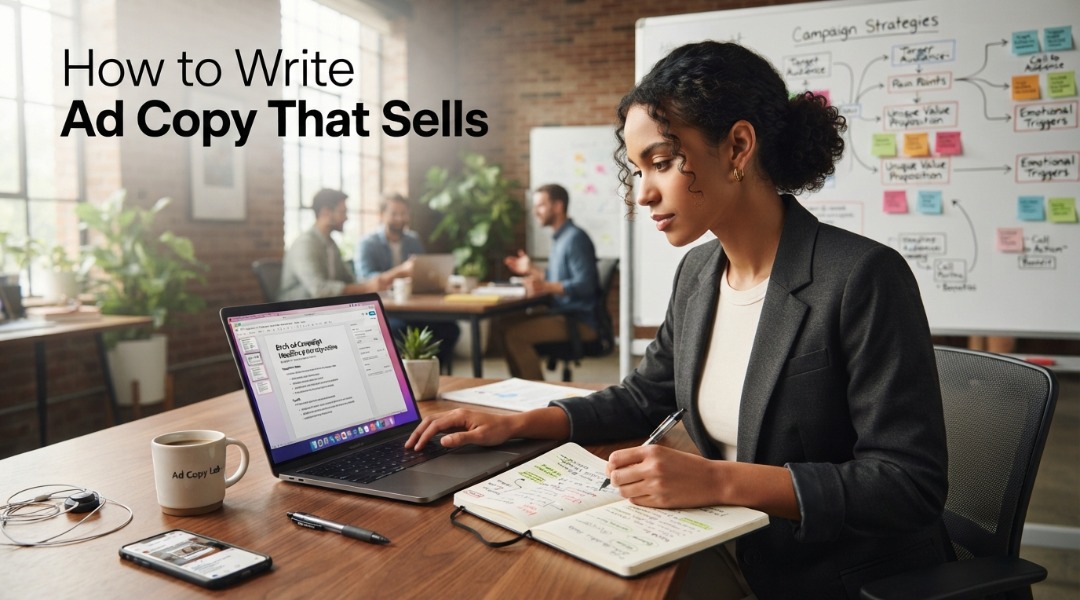
Write the ad in four parts: hook, claim, proof, and CTA. Each part should do one job, so readers can understand the offer without rereading it.
Start with that problem, yet follow it with an exact claim about every outcome. Which means add proof through a review phrase, process detail, guarantee, demonstration, or measurable feature. Finish with a direct action.
Here is a working proof for a meal-planning service:
| Copy part | Example |
|---|---|
| Hook | Dinner plans for busy weeknights |
| Claim | Get a full plan before your grocery trip |
| Proof | Recipes use ordinary supermarket ingredients |
| CTA | See this week’s menu |
The copy avoids inflated claims. Which means it tells the reader what changes, how the offer works, and what to do next. According to Silverspider Media’s ad testing guidance, change the headline or offer, not both at once. That rule protects your test from guesswork.
Moving on to something related, according to ClicksGeek advice on description lines, supporting text should explain why the problem matters before presenting the solution. Keep that idea in mind when your ad has room for a longer description.
How much proof should an ad include?
Use one proof point that answers the buyer’s biggest doubt; adding five weak claims usually makes the message harder to trust.
Under normal conditions, explain the process. If buyers doubt speed.
Show a review or sample. State who the offer serves and who should skip it. Plus, if they doubt quality; if they doubt fit.
That may feel risky, but narrow copy often attracts better clicks.
“Ad copy converts when the hook enters the reader’s existing internal conversation in three to five words.”
Pivoting slightly, what happens next? This guidance, published by AdLibrary, explains why problem language should appear early. Which means don’t hide the main benefit below a brand story.
Step 3: Adapt the Copy to Each Platform

Rewrite the same core promise for each placement instead of pasting one long ad everywhere. Mobile feeds need an immediate opening, while Google Ads needs several independent headlines.
For Meta Ads, make the first line work. Before the reader taps “See more”; put this problem or outcome first. Use short paragraphs, line breaks, and a single clear CTA to help most of us scan on a phone.
That connects directly to what was said earlier. This is where it gets practical. For Google Ads, write multiple standalone headlines. Because the platform can combine them in different ways, and each headline should make sense alone.
Build options around the problem, result, proof, and action rather than tiny wording changes.
According to Marketing Agency Singapore’s Google Ads guide, independent headline variations give Google more combinations to serve. The trade-off is control: a combination may sound less natural. So review the live preview before launch.
According to research by E. Darics, V. Koller, and B. De Clerck, workplace language works through context and audience expectations. That finding supports a direct rule: write like the buyer’s channel, not like a corporate brochure.
Step 4: Match the Landing Page
Place the same promise in the ad and the landing page headline, then repeat the offer and next action above the fold. A click is wasted when the page makes the buyer search for the promised benefit.
For the average user, if the ad says “See this week’s menu,” the page should show that menu first. Don’t send the visitor to a generic homepage, and message mismatch can produce strong click numbers and weak conversion. Because the visitor expected something else.
According to D. Howes’s 2021 work on sensory marketing, sensory cues can influence buying behavior. Usually speaking, for ad writers, the practical use is simple: describe the face. When the product depends on taste, texture, sound, or appearance, connect the description to a real offer.
Step 5: Test One Change at a Time
Publish versions that keep the audience, offer, format, and landing page stable while changing one element, like the hook, proof, or CTA.
For the average user, test the headline first. If the ad gets few clicks. Test the offer or proof if clicks arrive, but conversions stay low. Read results by funnel stage instead of naming a winner from one early signal.
A useful test sheet includes the version name, changed element, audience, placement, spend, clicks, conversions, and learning. Never change the image, headline, audience, and page together. So you may land a better result, but you won’t know why.
According to D. Halbheer, F. Stahl, and O. Koenigsberg’s 2026 study on digital content strategy, advertising revenue can shift with content access and demand response. For your campaign, that means testing the offer context matters, not just swapping adjectives.
In most scenarios, picking up that thread from. Before, according to Y. Wu and colleagues’ 2026 study on long text generation, longer text systems need extra reasoning to keep quality. The advertising lesson is narrower: don’t ask a writing tool for one perfect ad. Ask for a few different angles, then judge each against customer evidence.
Troubleshooting
Fix ad performance by locating the broken stage first: attention, belief, action, or page continuity. Each stage needs a different edit & few clicks:
Replace the opening with the buyer’s problem or desired result.
- Clicks but no sales: Compare the ad promise with the landing page headline and first section.
- High attention, weak trust: Remove vague superlatives and add one believable proof point.
- Mixed test results: Check whether more than one variable changed between versions.
- Low-quality leads: State the audience, price context, or offer limits more clearly.
Why does ad copy sound generic?
Generic copy usually comes from writing for a broad audience or listing features before identifying a specific buyer problem.
Pay attention to this part. In most scenarios, return to the source material. Plus, reviews and support messages constantly contain sharper language than a brand brief. The issue isn’t a lack of creativity; it’s a lack of evidence.
People Also Ask
What is the best structure for ad copy that sells?
Use a hook, claim, proof point, and CTA in that order.
This structure gives the reader a reason to stop, a clear outcome, evidence to reduce doubt, and one next action. It also makes future variants easier to compare, seeing as each line has a defined role.
How long should ad copy be?
Make it as short as the message allows, but don’t remove proof that answers a real objection.
Meta-style ads need a fast opening on mobile. Google Ads calls for multiple independent headlines. Length should follow the placement and buyer’s level of doubt.
Should ad copy mention features?
Mention a feature only after connecting it to a buyer outcome.“Automatic reminders” is weaker than “Get a reminder before each filing deadline” because the second line explains why the feature matters. Features support the claim; they shouldn’t replace it.
Can AI write ad copy that sells?
AI can produce useful variations, but customer evidence and human review must control the final message.
Writing platforms can combine angles quickly, yet they may invent wins or smooth away the plain language that makes an ad believable.
FAQs
How do you write ad copy that sells without sounding pushy?
In most scenarios, use a specific problem; a supported outcome; and a direct CTA. Avoid fake urgency, inflated claims, and broad promises that apply to everyone. Buyers usually respond better when the ad explains who the offer helps and what happens after the click.
What is the biggest ad copy mistake?
The biggest mistake is describing the product instead of the change it builds. A feature list may explain what you built. But it doesn’t answer the buyer’s question: “Why should I care right now?” Connect every feature to a result or remove it.
How many ad versions should you write?
Write a few different versions around the same offer, then test one variable at a time. Create different hooks, proof points, and CTAs, but keep the audience and landing page stable. This method gives you cleaner learning than launching unrelated concepts together.
Does landing page alignment affect ad conversions?
Yes, so it’s worth noting that the page should repeat the ad’s main promise, offer, and next action near the top. Arguably, when a visitor clicks for one thing and sees another, the mismatch makes doubt and wastes paid traffic, even. If the ad earned the click.
What to Do Next
Pull ten customer phrases today, turn three into hook-claim-proof-CTA drafts, and launch a controlled comparison tied to one matching landing page.
- Collect customer phrases, Pull wording from reviews, calls, comments, and support records.
- Choose one problem, Build the ad for a defined audience instead of trying to address everyone.
- Write four parts, Create a hook, claim, proof point, and CTA that lead to one offer.
- Match the page, Repeat the ad promise in the landing page headline and opening section.
- Test one variable, Change the headline, offer, proof, or CTA while keeping the rest stable.
If you follow that process, writing ad copy that sells becomes a repeatable method rather than a search for a clever sentence. Start with the buyer’s words. Then make every click feel expected.