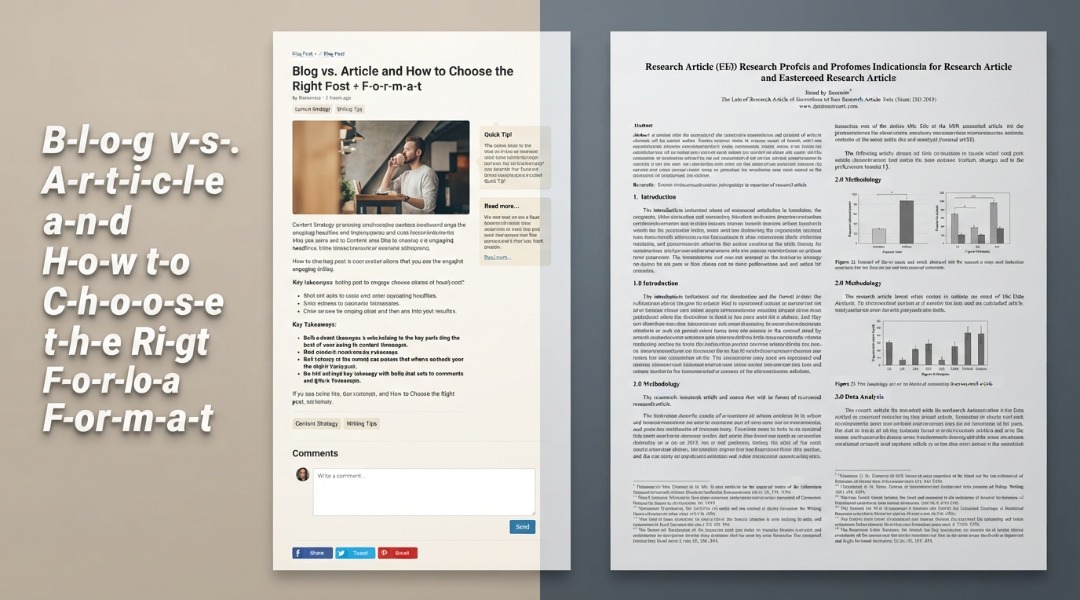
The choice between a blog and an article depends on the job your content needs to do, not on a strict rule about length or tone. If you’re a beginner writer, the labels can feel slippery: companies call posts articles, and blogs publish long-form pieces that might not be carefully sourced guides. Set a goal, identify each audience, and define the evidence standard before choosing a format.
Key Point
If you’re skimming, use this approach:
- Blogs invite return visits.
- Use article-style depth when readers need reliable explanations, evidence, and clear limits, such as in a guide to comparing business software.
- Purpose comes before the label.
Table of Contents
- What You’ll Need
- Step 1: Define the Job Your Content Must Do
- Step 2: Choose Blog or Article Structure
- Step 3: Draft, Check, and Publish the Right Format
- Troubleshooting and Common Mistakes
- People Also Ask
- What to Do Next
What You’ll Need
To choose between a blog post and an article, bring a clear audience, one reader problem, a publishing goal, and access to sources. Set aside about 30 minutes for the format decision; drafting and fact-checking take longer, especially for an evidence-heavy article.
You don’t need special software. A brief in Google Docs or Microsoft Word, a notes file, and a habit of checking sources will do. Beginner writers can follow the steps below. The challenging part isn’t the label; it’s matching the depth to the reader’s risk.
Gather these before drafting:
- The reader’s question, stated in one sentence.
- The intended result: traffic, engagement, an update, or a well-supported explanation.
- Sources you can verify, such as primary documents, expert interviews, or trusted reporting.
- A working headline and the call to action, if the page has one.
A blog can refer to a publishing format or an ongoing site. A blog post is usually an individual entry, while an article is usually one standalone piece. That distinction, discussed in user forums and writing guides, clears up a common source of confusion.
HostAdvice makes the format-versus-piece distinction useful: a blog can contain articles. But calling every post an article won’t make it deeply reported.
Step 1: Define the Job Your Content Must Do
Write one sentence that names the reader, their problem, and the result they need. If your page should spark a response or provide a timely update, use a blog-led approach. If readers need a careful explanation, plan article-level depth.
Start with the outcome, not the word count. A company update about a new service can be a short, conversational blog post. A comparison of services that asks readers to make a costly decision demands stronger sourcing, clear criteria, and room to explain trade-offs.
In most scenarios, ask what happens if a reader acts on your page. For a low-risk topic, personal experience and practical guidance may serve them well. For health, money, law, or technical claims, light opinion isn’t enough.
Set a higher evidence bar and direct readers to qualified sources where needed.
| Decision point | Blog-led post | Article-led piece |
|---|---|---|
| Main aim | Engage, update, or attract search visits | Explain, analyze, or build subject authority |
| Voice | Often conversational and personal | Often neutral, formal, or report-based |
| Evidence | Personal experience plus selected sources | More source checks, facts, and citations |
| Best fit | A timely tip or practical how-to | A durable reference or detailed comparison |
These are tendencies, not rules. Recent writing guides describe blogs as more personal and articles as more formal.
Online publishing mixes both styles. Eleven Writing and Make a Living Writing discuss the usual differences. Neither label should replace a reader-focused brief.
Is a blog post less authoritative than an article?
No. A blog post can earn trust when it supports claims with strong evidence and explains its limits. An article can feel weak if it makes broad claims without showing sources.
For the average user, the gap always lies not in the format but in the reporting. A quick personal post can be credible about a writer’s own workflow, yet it can’t stand in for independent evidence about a whole market.
For SEO planning, connect the content with search intent and the reader’s next question. This connects naturally with keyword use in content without turning the page into a keyword exercise.
“Choose the depth your reader’s decision demands, then choose the label.”
Step 2: Choose Blog or Article Structure

Choose a blog structure for timely, flexible writing that benefits from a direct voice. Choose an article structure when the subject calls for organized analysis, verified claims, and citations readers can check.
Make the choice with an outline. A blog post all the time starts with the reader’s immediate problem, then offers a useful answer, examples, and a next step. An article usually frames a question, sets its scope, builds an explanation from evidence, and reaches a measured finding.
Zooming out a bit, these are drafting choices, not separate containers. A blog can host a formal research piece, and an online article (though exceptions exist, naturally) can sound warm and direct.
For the average user, don’t pad an article to make it seem authoritative. Likewise, don’t strip evidence from a blog to make it feel casual.
Use this test while outlining:
- If a timely event makes the page useful, add a date and plan to review it.
- If readers need a repeatable process, give each action its own clear section.
- If the answer depends on evidence, cite the source beside the claim and explain what it does not prove.
- If readers need to compare options, state the criteria before discussing the choices.
Length follows the work. Current guides offer varying ranges, so no single word count separates the forms. A short, well-sourced article can be more useful than a sprawling post. A how-to blog post may need detail because readers must carry out the steps.
Step 3: Draft, Check, and Publish the Right Format
Draft from the outline, then check whether every section serves the reader’s goal. Before publishing, verify claims, links, tone, and the page’s promise so readers don’t get a casual post when they expected careful analysis.
Write the first draft in the chosen voice. In a blog-led piece, first person can clarify what you personally observed; distinguish that observation from claims about other people. In article-led writing, use neutral phrasing where it improves clarity. But don’t hide who made a judgment or where the evidence came from.
Then edit in passes; to start, check the logic: does each heading answer part of the reader’s question? Next, check the sources: can a reader trace big-deal factual claims to a credible page or document? Last, remove repeated points and trim sections that don’t help someone act or understand the topic.
A familiar workflow helps. WordPress and Ghost both support blog publishing, while Google Docs and Microsoft Word work for drafting and review. These solutions don’t figure out the format; the brief and editorial checks do.
For a search-focused piece, also look at how a clear answer may appear in search results, as described in this guide to AI search visibility.
- Name the reader, Write down the audience and the problem they want solved.
- Set the goal, Pick engagement, a timely update, or a detailed explanation.
- Choose the evidence level, Match source depth to the risk of acting on the claim.
- Outline the answer, Organize headings around the reader’s next questions.
- Verify before publishing, Check claims, links, tone, and whether the page delivers its promise.
Troubleshooting and Common Mistakes
When a draft feels mismatched, compare its tone, evidence, and structure with the reader’s task. Fix the mismatch at the outline or source stage; changing the label at publication won’t solve a weak argument. The post sounds opinion-heavy.
Add credible sources for factual claims, and mark personal views as opinion.
- The article feels padded. Cut repeated background; use an example or source only when it advances the explanation.
- The title promises research, but the draft has none. Change the promise or do the reporting. Don’t leave the mismatch for readers to discover.
- The voice feels stiff. Keep precise sourcing, then simplify sentences and explain technical terms in ordinary language.
The normal error is treating tone as the whole distinction. So tone matters, but evidence and purpose carry more weight. A chatty article with sound sourcing can work; a polished post with unsupported claims still has a credibility problem.
Should you call a web post a blog or an article?
Use the term your audience understands, then make the format clear through the page’s purpose and structure.
A site may call its publishing section a blog and label individual entries posts, even when some entries read like researched articles. Consistent labels help navigation and readers. However, judge the content by whether it answers their question and supports its claims.
People Also Ask
Readers constantly ask whether these labels set firm rules. They don’t. The useful distinction lies in how you plan, research, and present a piece.
What is the main difference between a blog and an article?
A blog can mean an ongoing publishing site or a conversational post, while an article usually means one standalone piece of writing.
It all goes back to that earlier idea: in practice, blogs may publish articles, and articles may appear on blogs. Decide by the goal, depth, voice, and evidence your reader demands, rather than by the publishing platform alone.
Is an article always longer than a blog post?
No. Length varies by subject and purpose, and there’s no universal word-count cutoff that makes a piece an article.
A short article can answer a narrow question with verified facts. A detailed blog tutorial can be longer, since readers need each action explained. Draft until the reader has a complete answer, then remove material that adds no value.
Can a blog post use research and citations?
Yes. A blog post can use interviews, cited sources, and careful analysis while keeping an accessible voice.
Citations matter whenever a factual claim could shape a reader’s decision. Link to original or trusted material where possible, and separate your interpretation from the evidence itself.
Which format works better for SEO?
Neither format ranks by label alone; useful content that matches the searcher’s need is the stronger choice.
A how-to post can serve a practical query, while a detailed article can satisfy a comparison or research need. Make the page clear to scan, answer the query plainly, and keep factual claims accurate.
What to Do Next
Take your next assignment and write a one-sentence brief before drafting. Name the reader, the question, and the result; then decide how much evidence the answer needs.
In most scenarios, that small step settles most Blog vs. Article debates. If readers need a snappy update or a useful conversation, shape a blog-led post. If they need a dependable explanation, build article-level sourcing and structure, even when the piece will live on a blog.
You’ve probably found that before publishing, you should check that the headline, tone, and evidence make the same promise. Then share the piece where your audience expects to find it and plan a review if the information can change.