
If you’ve ever tried to squeeze a 400-page novel into two paragraphs, you know the frustration. Summarizing a story isn’t simply a matter of shortening it.
You have to find the narrative spine and strip away everything else. The familiar beginning-middle-end structure is easy to remember and teach, which is why users and teachers like it, and why many solid summaries start there. According to a 2020 study by N. Wexler, knowing how to summarize makes you a better reader because the two skills are closely connected.
- Read the full story twice: first for understanding, then to identify characters, conflict, and resolution.
- Use the SWBST framework (Somebody, Wanted, But, So, Then) to extract the plot skeleton in your own words.
- Keep it short; if your summary is nearly as long as the original, you’ve included too much detail.
Key Takeaways
If you’re skimming, here’s what actually matters:
- The best summaries answer five questions: who, what they wanted, what blocked them, how they tried, and how it ended.
- Story maps and outline-style notes make longer stories easier to condense, according to user feedback from educators and writers.
- A summary that retells every event isn’t a summary. Trim ruthlessly.
- Chronological order matters more than creative structure because readers need to follow the plot from start to finish.
Table of Contents
- What You’ll Build
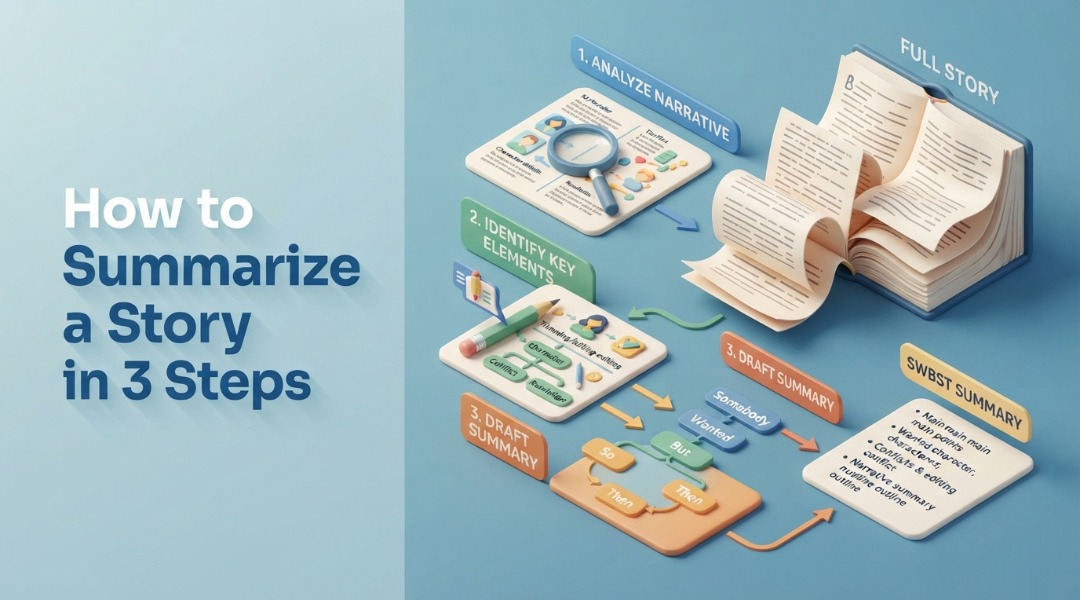
- Step 1: Read and Map the Story
- Step 2: Extract the Core with SWBST
- Step 3: Write, Trim, and Verify
- People Also Ask and Next Steps
What You’ll Build
A story summary is a condensed version of a narrative that captures the main characters, central conflict, key plot events, and resolution while leaving out minor details and side plots. You’ll build a 150-to-300-word summary that follows chronological order and uses your own sentence structure rather than copying the original text.
You’ll finish with a summary that answers five core questions: who the story is about, what they wanted, what problem they faced, how they tried to solve it, and how it ended. This structure works for a short story, a novel chapter, or a full book.
According to a 2026 study by S. Wu, even professional journalists bit by bit use AI tools to summarize news stories. But the human ability to identify what matters most remains the core skill. Machine-generated summaries can miss nuance; your job is to catch what machines can’t.
Prerequisites
Before you start, gather three things: the full text of the story (not a partial excerpt), a notebook or digital document for notes, and about 45 minutes of focused time for a typical short story. Longer works may take two hours. A Google Doc or Notion page works fine; no special software is required.
Step 1: Read and Map the Story
Read the story from start to finish without taking notes on the first pass. Then read it again, this time marking the setting, main characters, central conflict, major plot events, and resolution. Organize your notes in story order so you can see how the narrative develops from beginning to end.
The first read matters more than people think. Experience the story as a reader, not an analyst. If you start highlighting right away, you’ll mark everything and retain nothing.
Read clean the first time. Let the story wash over you.
On the second pass, get surgical. Grab your notebook and track five elements: the setting (where and when), the main characters (who drive the action), the central conflict (what problem creates tension), the key events (what happens and in what order), and the resolution (how it ends).
According to a 2022 study by Meuschke et al., narrative structure follows predictable patterns: change, escalation, and turning points form what researchers call the story’s spine. Map these elements on your second read, and you’re not guessing. You’re following a structure that already exists in the text.
Some users prefer story maps or outline-style notes to make longer stories easier to condense. If you’re working with a novel, try a simple table: one column for chapter numbers, another for the key event in each chapter. This layout helps you spot which events are load-bearing and which are decorative.
Expected Result: A set of chronological notes covering setting, characters, conflict, key events, and resolution, organized in story order.
Step 2: Extract the Core with SWBST
Use the SWBST system to distill your notes into a single plot skeleton: Somebody (who), Wanted (what they wanted), But (the obstacle), So (what they did), Then (how it ended). This five-part formula forces you to identify the main narrative arc and discard everything else.
SWBST works because it gives you a clear formula for what to include. Instead of staring at a blank page, wondering where to start, answer five specific questions: Who is the main character?
What did they want? What stood in their way? What did they do about it? How did it end?
The structure is simple by design. Its simplicity keeps you from drifting into retelling mode. When you have to explain what a character wanted in one sentence, you naturally cut subplots and minor characters.
According to a 2023 study by Acerbi and Stubbersfield, people who summarize stories in transmission chain experiments consistently retain the core narrative while stripping away secondary details. SWBST replicates this natural human tendency in a structured way. It gives a structure to a process your brain already wants to follow, and helps you stay on track.
How does SWBST handle complex stories with multiple plot lines?
For complex narratives, apply SWBST to each major character separately, then identify which arc is the primary thread. Summarize that main arc in full and briefly reference secondary arcs only if they directly affect the primary conflict’s resolution.
SWBST can feel too reductive for stories with multiple plot lines. That’s a real limitation. According to a 2024 study by Huang et al. on multi-document summarization, summarizing diverse information requires asking targeted questions about each narrative thread rather than trying to compress everything into one linear account.
Expected Result: A five-sentence plot skeleton using SWBST that captures the main narrative arc in your own words.
Step 3: Write, Trim, and Verify
Write your summary in chronological order using the SWBST skeleton as your guide, then check the length against the original. If your summary is nearly as long as the source text, you’ve included too much detail and need to cut descriptive passages, minor events, and side plots.
Turn your skeleton into flowing prose. Start with the setting and main character, introduce the conflict, and move through the key events in order. End with the resolution. Use your own words and sentence structure; never copy phrases from the original text.
Here’s where most summaries go wrong: writers keep extra descriptions because they feel important. They’re not. According to a 2024 study by Angelucci and Prat, people who receive summarized information retain the key facts nearly as well as those who read the full version, provided the summary focuses on the main narrative arc. Cutting detail doesn’t lose meaning; it sharpens it.
Ideal Summary Length vs. Original Text (Words)
The chart shows a typical ratio. For a 2,000-word short story, aim for a summary of 150 to 300 words. For an 80,000-word novel, aim for 500 to 800 words.
If yours runs longer, stop and ask: does this sentence advance the main conflict? If not, cut it.
Is my summary too long?
If your summary exceeds one-third of the original text’s word count, it’s too detailed. A good summary is clearly condensed, not a retelling. Cut any sentence that describes scenery, character appearance, or events that don’t directly affect the main conflict’s resolution.
If the story has a clear theme or lesson, include it at the very end in one sentence. Don’t analyze the theme; just state it. “The story suggests that forgiveness requires confronting the past, not burying it.” Done. Move on.
Expected Result: A 150-to-300-word summary in your own words that follows chronological order, captures the main conflict and resolution, and reads as a clearly condensed version of the original.
People Also Ask and Next Steps
What is the SWBST method for summarizing stories?
SWBST stands for Somebody, Wanted, But, So, Then. In this five-part structure, identify who the story is about, what they wanted, what obstacle they faced, what they did about it, and how it ended. Teachers and writers use it because it offers a clear way to separate the main plot from minor details.
How long should a story summary be?
A summary should be roughly 10 to 15 percent of the original text’s length. For a 2,000-word short story, that means 200 to 300 words.
Should I include the theme in my summary?
Include the theme only if the story has a clear one, and keep it to a single sentence at the end. Don’t analyze or interpret it. Just state the lesson briefly, then stop. A summary should focus on plot, not literary analysis.
Can I use AI tools to summarize a story?
You can, but use caution. According to the 2026 study by S. Wu, journalists use AI tools to help summarize stories, but human judgment of what matters most remains irreplaceable. AI-generated summaries can miss emotional nuance and thematic depth that a human reader catches naturally.
How do I summarize a story with multiple plot lines?
Run the SWBST system for each major character arc separately. Then identify the primary thread and summarize it in full. Reference secondary arcs only if they directly affect how the primary conflict resolves. Don’t give every subplot equal space.
- Read the full story, Experience it once without taking notes to understand the complete narrative arc.
- Map key elements, On a second pass, note the setting, characters, conflict, climax, and resolution in chronological order.
- Apply SWBST, Write five sentences answering who, wanted, but, so, and then to create your plot skeleton.
- Draft your summary, Convert the skeleton into flowing prose using your own words and sentence structure.
- Trim and verify, Cut any sentence that doesn’t advance the main conflict and confirm the summary is clearly shorter than the original.
Where to go from here
Now that you know how to summarize a story, practice on a short story you already know well. Familiarity lets you focus on technique rather than plot comprehension.
Next, try summarizing a chapter of a longer novel to test your ability to handle subplots. You can also explore how to write a summary of a story for a complementary approach, or check out practical ways to improve your content writing skills to sharpen your overall craft.
To connect storytelling techniques to broader writing goals, this guide on creative content writing is worth your time.