
Summarizing a story feels hassle-free until you actually sit down to do it. You read a fantastic short story or novel chapter, and your mind goes blank when the teacher asks for a summary. As far as I know, learning how to write a summary of a story means stripping a narrative down to its core without losing the meaning. That takes a specific set of skills you can build step by step.
In practice, if you’re skimming and want to know how to write a summary of a story, here’s what actually matters.
- A summary shortens a story to its most important ideas, not every event.
- Use the Somebody Wanted But So Then framework to organize your thinking before you write anything.
- Keep it in present tense and your own words; one instructional resource suggests staying well under 25 words for very brief tasks.
- Pin down characters, setting, conflict, climax, and resolution before you draft a single sentence.
Table of Contents
- What You’ll Build
- Prerequisites
- Step 1: Read the Story Twice
- Step 2: Identify Core Story Summary Elements
- Step 3: Draft a Story Summary Using Somebody Wanted But So Then
- Step 4: Write in Your Own Words
- Step 5: Trim and Verify
- People Also Ask
- Next Steps
- Conclusion
What You’ll Build
By the end of this tutorial, you’ll produce a concise story summary that captures the main character, central conflict, key events, and resolution in roughly 3 to 5 sentences. You’ll also have a repeatable process for any narrative, whether it’s a 500-word short story or a full novel chapter. Each goal is a summary that someone who never read the story could wrap their head around completely.
Prerequisites
You need a story in short, something to take notes with, and about 20 to 30 minutes. Plus, no special software. That matters: if you’re working with a longer text, having highlighters or a notes app helps. This detail matters more than it might seem right now.
Most educators note that longer texts benefit from note-taking during reading rather than after. For shorter pieces, you can summarize after reading the full text. A basic understanding of creative content writing concepts like character and plot helps but isn’t required.
Step 1: Read the Story Twice

Read the story once for enjoyment, without taking notes; then read it a second time. Actually look for plot points, conflict, and theme, because teaching guides widely recommend this second pass for accuracy and coherence.
On the first read, just absorb what happens. Don’t worry about analysis. On the second pass, jot down key moments: who the main character is. Where the story takes place, what problem they face, what happens at the turning point, and how it ends.
“Summarizing means you shorten what you read to the most important ideas.”, IES REL Southeast
When you look closely, this definition from the Institute of Education Sciences captures the core principle, so you’re not retelling, and you’re shrinking.
Expected Result: A rough list of 5 to 7 key story moments.
Step 2: Identify Core Story Summary Elements
Every story summary needs six ingredients: characters, setting, conflict, climax, resolution, and theme. Label each one before you write your summary paragraph.
Characters are who the story follows. Setting is where and when it happens. Conflict is the central problem.
In real-world terms, climax is the turning point. Resolution is how things finish. Theme is the deeper message.
This is exactly what that first point led to: a 2023 study by Eldan and Li on small language models found that even simple story summaries need coherent character motivation and clear resolution to make sense.
Not exactly what you’d expect; if a summary skips the “why” behind a character’s actions, it falls apart. So make sure your notes capture motivation, not just events.
Expected Result: Under normal conditions, a labeled list with all six elements filled in.
Step 3: Draft a Story Summary Using Somebody Wanted But So Then

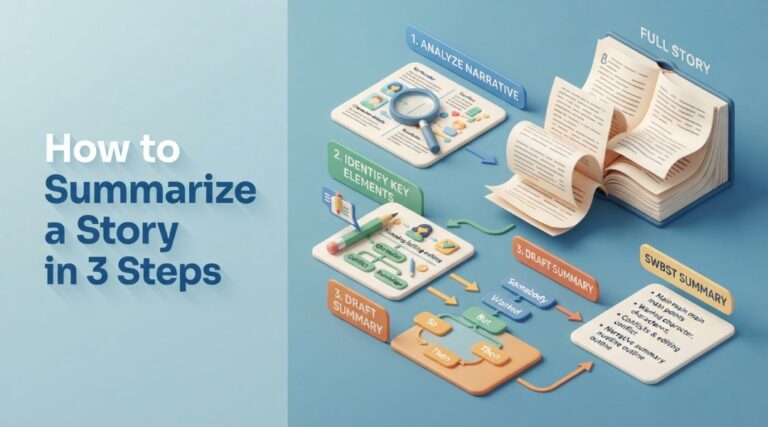
You should remember five prompts: identify the main character, what they wanted, what blocked them, what they did, and how it ended. Fill in each part with one sentence, then combine them into a paragraph.
Here’s how the system breaks down:
- Somebody: Who is the main character?
- Wanted: What did they want or need?
- But: What obstacle stood in their way?
- So: What did they do about it?
- Then: How did the story resolve?
You’ve probably found that, and sure enough, this structure, widely used in elementary and middle-school classrooms & works. Since it forces you to focus on the narrative spine.
What’s the catch with this framework?
It all goes back to that earlier idea: it can become too rigid if you apply it mechanically. Some stories have multiple main characters or nonlinear timelines. In those cases, adapt the structure. Use it for the number-one plotline and add a sentence for secondary threads if needed. The structure is a starting point, not a cage.
Expected Result: A 3 to 5 sentence draft summary.
Step 4: Write in Your Own Words
Rewrite your draft in present tense using your own vocabulary. Don’t copy phrases from the original text, and leave out opinions unless your assignment asks for them. This convention is standard across classroom resources.
Especially when the story has rich detail, writing in your own words is harder than it sounds. Many learners report this as the toughest part, so the trick is to close the book.
Consider this: after taking notes, then write from your notes alone. So this forces genuine understanding and reduces plagiarism risk.
If you want to improve your content writing skills, this exercise is one of the best ways to practice.
On stepwise summarization found that breaking the process into stages produced more accurate summaries than writing in a single pass. So don’t try to do everything at once.
Expected Result: A clean draft in present tense using your own vocabulary.
Step 5: Trim and Verify
Cut every minor detail from your draft. If a sentence does not advance the main plot or reveal the central conflict, remove it. Then check that your summary stays well shorter than the original text.
Then again, one practical rule from instructional videos. Try to keep summaries seriously short by focusing on big ideas. One teacher resource suggests that 25 words or more is usually too long for an incredibly brief summary task. For classroom summaries, the target is, as a rule, much shorter than the original text.
Here’s a rapid comparison of summary lengths:
| Summary Type | Word Count | What to Include |
|---|---|---|
| Ultra-brief | Under 25 words | Character, conflict, resolution only |
| Standard classroom | 50 to 100 words | All six elements in 3 to 5 sentences |
| Extended | 150 to 200 words | Six elements plus one supporting detail |
Read your summary out loud; if someone who rarely reads the story can tell you what happened, you’re done. If they look confused, you probably left out the conflict or resolution.
For more on writing better content, clarity should always be your top priority.
- Read your story twice, First pass for enjoyment, second pass to note key plot points and conflict.
- List the six core elements, Write characters, setting, conflict, climax, resolution, and theme as short phrases.
- Fill in the SWBST framework, Answer Somebody, Wanted, But, So, Then with one sentence each.
- Rewrite in present tense, Put away the original text and convert your draft to present tense using your own words.
- Cut minor details, Remove any sentence that doesn’t advance the main plot or reveal the central conflict.
- Read aloud to verify, If a stranger could understand the story from your summary alone, you’re finished.
Expected Result: A final, polished summary of 3 to 5 sentences.
People Also Ask
A story summary should include characters, setting, conflict, climax, resolution, and theme. These six elements give the reader enough context to get what happened and why it mattered without reading the full story.
Circling back for a moment, lately, an insanely brief summary should stay well under 25 words, according to one instructional resource. For classroom assignments, summaries are usually much shorter than the original text, often 3 to 5 sentences covering only the main plot points.
Yes. Classroom stuff you need consistently recommends present tense for story summaries. Writing “the character runs” instead of “the character ran” keeps the summary active and is standard academic convention.
No, unless your assignment, in particular, asks for it. Summaries should be goal reports of what happens in the story; including opinions or quotations weakens the summary’s purpose. Which is to show comprehension of the main ideas.
Across the board, it’s a five-part structure for organizing narrative summaries. You identify who the main character is, what they wanted, what blocked them, what they did about it, and how the story ended. What this means is it’s widely used in schools, as it simplifies story structure.
Next Steps
Once you’ve mastered single-story summaries, try these extensions. First, summarize a full novel chapter by chapter, then combine those chapter summaries into a one-paragraph book summary.
On top of that, compare two stories with similar themes and write a summary that covers both; then practice writing summaries of different lengths: a 25-word version, a 50-word version, and a 100-word version of the same story. Each length forces different choices about what to include.
Plus, if you’re also working on humanizing your academic writing, these summary skills transfer head-on.
Conclusion
So, knowing how to write a summary of a story comes down to reading carefully, identifying the core elements, using a painless system, and writing in your own words. The Somebody Wanted, But So Then method gives you a reliable structure.
Present tense keeps it active. More often than not. If you follow these five steps, you’ll produce summaries that are clear, accurate, and genuinely useful, and the best part?
This process works for any story you encounter, from a short story in class to a full-length novel.