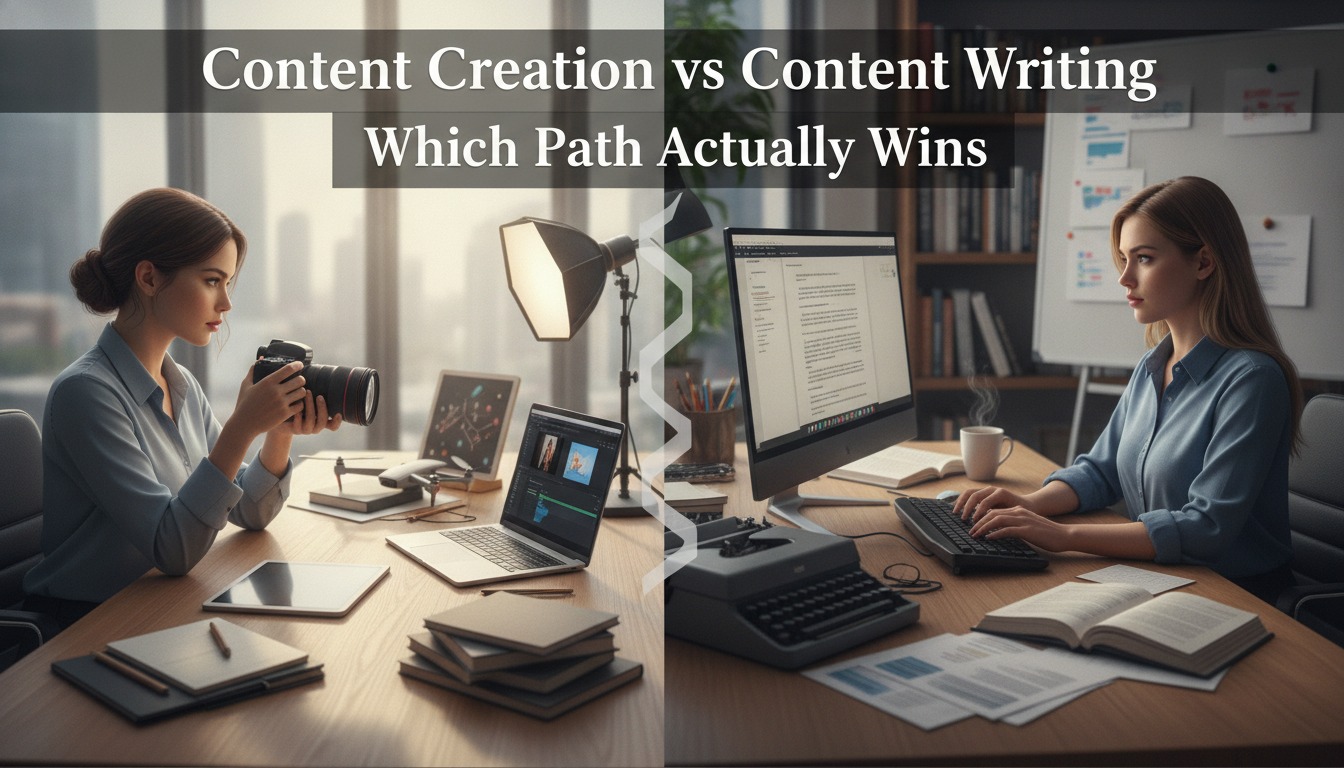

The debate around content creation vs content writing isn’t academic anymore. It’s a fork in the road that figures out how you spend the next five years of your career. How much you earn. Whether your skills stay tied to as AI platforms eat into traditional freelance work.
Select writing and you’re betting on depth. Authority, and SEO mastery.
Then again, pick creation and you’re betting on multi-platform reach — visual storytelling, and riding the wave of short-form video. Who would’ve thought? The wrong choice doesn’t just cost you time.
In the end, it can leave you competing with free AI apps for rock-bottom per-word gigs, hmm, let me put it differently, while someone with a ring light and decent editing skills out-earns you five to one.
- Content writing focuses on text-based work like blogs and whitepapers, driving organic search traffic through deep, long-form authority pieces.
- Content creation covers video, audio, graphics, and social posts designed for engagement and virality across multiple platforms.
- Writing faces mounting pressure from AI tools, while creation demands expensive equipment but offers more diverse income streams.
Table of Contents
- Content Creation vs Content Writing at a Glance
- What Is Content Writing?
- What Is Content Creation?
- Head-to-Head Comparison
- Which Should You Choose?
- People Also Ask
- Final Verdict
Key Point
- Content writing requires almost zero startup capital (a laptop and internet connection), making it the lowest-barrier entry point for new freelancers.
- Content creation demands investment in cameras, lighting, editing software, and sometimes paid platform tools, but unlocks multiple revenue streams like sponsorships and merchandise.
- The creator economy is projected to hit roughly $480 billion by 2027 per Goldman Sachs analysis, meaning the pie is growing fast enough to support both paths if you pick the right one.
- Writers who learn to script and storyboard for video formats gain a hybrid advantage that neither pure writers nor pure creators can easily replicate.
Content Creation vs Content Writing at a Glance
Content creation vs content writing comes down to format breadth versus depth: writing is a text-only discipline focused on SEO and organic traffic, while creation spans video, audio, graphics, and social posts built for engagement across platforms. The comparison table below breaks down six key attributes side by side. You can see where each path excels, and where it falls short.
| Attribute | Content Writing | Content Creation |
|---|---|---|
| Core Format | Text (blogs, whitepapers, articles) | Multi-format (video, audio, graphics, social) |
| Startup Cost | Very low (laptop + internet) | High (camera, lights, editing software) |
| Primary Skill | SEO knowledge, long-form structure | Narrative editing, visual storytelling |
| Income Streams | Per-word rates ($0.10–$1.00/word), retainers | Sponsorships, merchandise, ad revenue, courses |
| AI Threat Level | High (text generation is mature) | Moderate (AI video/audio still catching up) |
| Burnout Risk | Moderate (isolated, slow feedback) | High (constant ideation, multi-role demands) |
What Is Content Writing?
Content writing is the practice of producing text-based material, primarily blogs, whitepapers, articles, and landing pages. Designed to drive organic search traffic (at least based on current observations) and build topical authority. Writers specialize in SEO structure, keyword integration, and long-form educational content that ranks on Google, and nurtures (and the data generally agrees) leads through a sales funnel.
The biggest strength here is depth. A well-researched 2,000-word article can rank for years. Pulling in traffic without ongoing investment. That’s compound equity, writing also builds trust faster than most video formats. Because people who read long-form content are already in a learning mindset, which makes them more receptive to authority signals.
Over the past few years, the weaknesses are real and getting worse, and according to discussions across Reddit’s freelance communities. Many writers feel their work is being devalued by AI apps, and low-cost content mills. When someone can generate a passable 1,500-word blog post in 30 seconds, your per-word rate starts looking indefensible to budget-conscious clients.
The isolation is another factor. Writing is solitary work with no immediate audience feedback loop. You publish — wait weeks for traffic data, and adjust.
The ideal user? Someone who loves research.
Has patience for SEO mechanics, and wants low overhead. If you become a content writer with strong fundamentals, the barrier to entry is almost zero.
You need a laptop and an internet connection. That’s it.
What Is Content Creation?
Content creation is the broader discipline of producing multi-format material including video. Audio, graphics, social media posts, and interactive media designed for engagement, and distribution across platforms like TikTok, Instagram Reels, YouTube, and podcasts. You’ve probably wondered the same thing. Most people feel the same way about it. Creators wear many hats together: writer, editor, on-camera talent, and strategist.
The advantage is reach. Short-form video on platforms like TikTok and Reels is the fastest-growing content format right now, which means a single viral clip can outperform months of SEO-improved blog posts in raw visibility. Here’s the other side of it. Creation also opens up more diverse income streams.
Sponsorships, merchandise, ad revenue sharing, online courses. A writer gets paid per word or per project. A creator can monetize the same audience five different ways. File that away.
You’ll see why it matters in a bit.
The trade-off is cost and complexity, and a decent camera setup, lighting, microphone, and editing software will set you back hundreds to thousands of dollars before you publish a single piece, and the burnout risk is severe. Creators a lot report that they have to be “everything” at once. Writer, editor, actor, marketer. That’s a crushing workload for one person,. I mean, especially when platform algorithms reward consistency over quality.
Still, the upside is undeniable, and honestly, from what we can tell, and media industry,” with a projected valuation approaching $480 billion by 2027. Kind of surprising, right? Make of that what you’ll. The current market sits at roughly $250 billion. That’s not a niche anymore. That’s a sector.
The ideal user is someone comfortable on camera, energized by audience feedback, and willing to invest in equipment, and learn multiple skills together.
Head-to-Head Comparison
Across three critical dimensions (cost, growth potential, and career longevity). Content creation and content writing serve night and day goals. Here’s how they stack up when you force a decision in each round.
Round 1: Cost and Barrier to Entry
Writing wins this round decisively. You can start today with a laptop and a free Google Docs account. 00 per word depending on niche, and run into, and (and rightly so) there’s no equipment overhead. Creation demands upfront investment in hardware.
Round 2: Growth Potential and Virality
Creation dominates here. Short-form video is the top-performing format for organic reach, and a single well-timed Reel. More importantly, or TikTok can generate more impressions in 48 hours than a blog post accumulates in six months.
Let that sink in for a second. Writing builds compounding authority over time, but it’s a slow burn.if speed-to-audience matters.
Is AI really killing content writing jobs?
Naturally, not killing, but radically reshaping them. AI text generation is mature and accessible. As it turns out. Which puts direct downward pressure on per-word pricing for generic content. It is up to you.
Still, writers who adapt by specializing, building strategy skills, and moving toward retainers are (and the data generally agrees) still in demand.
Round 3: Career Longevity and AI Threat
In practical terms, that’s where the stakes get real. AI vs human content writing comparisons show that fixes can now produce passable articles at scale, which puts direct pressure on text-only freelancers. Nine times out of ten, but haven’t reached the same threat level for multi-format creators yet.
Granted, writers who adapt aren’t doomed. Ann Handley, a respected voice in marketing, puts it bluntly. The script is the foundation of any video or audio project. Bad script means failed content, so the real question isn’t whether AI replaces writers.Winner.
Which Should You Choose?
Your choice between content creation vs content writing depends on your (a detail often overlooked) resources — personality, and risk tolerance. There’s no universal right answer, but there’s a right answer for you based on. Where you sit on three axes: budget, comfort with visibility. Patience for compound results.
Choose Content Writing ifyou’ve limited startup capital, prefer deep research over performing, and want to build authority in a specific niche over time. Writers who understand SEO and can produce emotionally engaging content will always have demand, even as AI commoditizes mediocre writing.Choose Content Creation if you’re energized by being on camera, have capital to invest in equipment, and want faster audience growth with multiple monetization paths. You’ll need to tolerate higher burnout risk and the pressure of constant ideation.
The way AI is changing content writing means pure text roles are shrinking. The creators who win long-term are the ones who can write well. And produce across formats.
- Audit your current skills — List what you can already do (writing, editing, on-camera work) and identify the single biggest gap between you and your target path.
- Start with the lowest-cost option — If budget is tight, begin with writing gigs to fund your first content creation equipment purchases.
- Learn one new format per quarter — Add video scripting in Q1, basic editing in Q2, and on-camera presence in Q3 so you build hybrid skills without burning out.
- Track your income mix monthly — Monitor which revenue streams (per-word, retainers, sponsorships, ad share) actually grow so you can double down on what works.
People Also Ask
Can a content writer become a content creator?
Basically, what that means is: blocksep matters. Yes, and the transition is easier than most people think.
Now, writers already have the hardest skill to teach: structured storytelling. Learning basic video editing and on-camera presence takes weeks, not years.
On the surface, and your existing writing ability gives you an immediate advantage in scripting and storyboarding that pure creators constantly lack.
Is content writing still profitable in 2026?
Now, profitable, yes, but the pricing model is shifting fast. Per-word rates are under pressure from AI platforms, so successful writers are moving toward retainers. Strategy consulting, and specialized niches where expertise commands premium rates. Generic blog writing is commoditizing, but expert-level content still sells.
Do content creators need to be good writers?
Not necessarily for every format. But strong writing (and that implies quite a bit) makes every format pull off better. Scripts — captions, video descriptions, and email newsletters all takes writing skill. The consensus among top creators is that writing is the foundation that makes everything else work. More data needed. Even if the audience never sees the raw text.
What equipment do I need to start content creation?
At minimum: a smartphone with a decent camera, a tripod. A clip-on microphone (around $20 to $50). And a free editing app like CapCut.
Puts things in perspective. Start there and upgrade as revenue comes in. Don’t fall into the trap of buying expensive gear.
Before you’ve validated your content strategy and found your audience.
Final Verdict
Sure enough, in the content creation vs content writing debate. Neither (depending entirely on the context) path is objectively superior. But if forced to pick one for someone starting today with limited the stuff you need, writing is the smarter entry point. It costs nothing to start, builds transferable skills. And gives you a foundation to expand into creation later.
In the web marketing world, that said, pure writing roles are shrinking under AI pressure, so the growing consensus is that “just writing” is no longer enough to survive. The follow-up question is obvious. Produce across formats. Start with writing, don’t stop there.