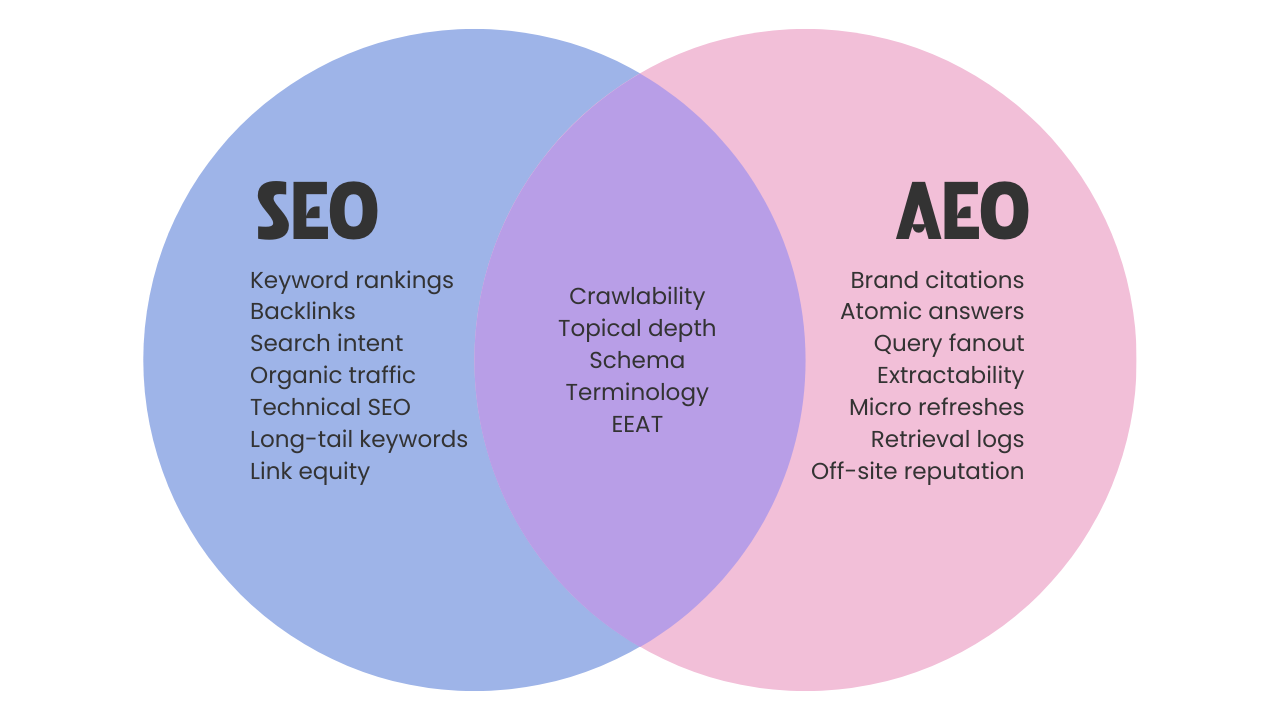

Search behavior is fracturing. If you’re wondering how does AEO differ from standard SEO, which means classic search engine improvement fights for page one rankings. From a practical standpoint, answer engine optimization fights to be the single synthesized response an AI assistant reads aloud.
Choosing the wrong strategy means losing either your organic traffic or your brand authority.
Main points
- SEO drives measurable site traffic.
- AEO builds brand citations inside AI answers, even when users never click through to your website.
- Relying solely on classic rankings will cause your visibility to drop as zero-click searches increase.
The short version
- Traditional SEO targets human clicks through search results page rankings and relies heavily on backlinks.
- Answer engine optimization targets AI responses by formatting content for machine extraction and semantic clarity.
- Modern marketers need both strategies because AEO builds authority while SEO drives actual site conversions.
Table of Contents
- Answer Engine Optimization vs Traditional SEO at a Glance
- Traffic and Visibility: AEO vs SEO Head-to-Head
- Content Structure and Metrics: AEO vs SEO
- Which Strategy Should You Choose in 2026?
- People Also Ask
Answer Engine Optimization vs Traditional SEO at a Glance
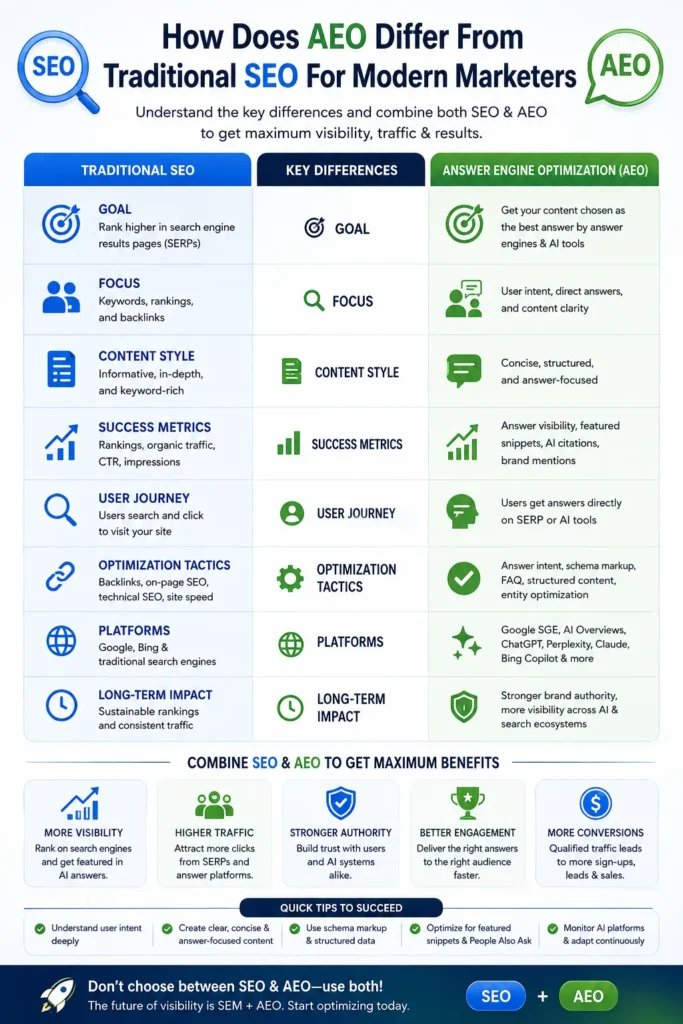
Answer engine optimization targets AI-generated responses by formatting content for machine extraction and semantic clarity. Traditional SEO targets human clicks through Google results page rankings, relying heavily on backlinks, metadata, and page-level relevance to drive measurable site traffic.
For the average user, understanding how AEO differs from traditional SEO starts with their core definitions. AEO focuses on becoming the definitive source for AI models. SEO focuses on climbing the organic leaderboard.
What exactly is answer engine optimization?
Answer engine optimization is the process of structuring digital content so AI systems can easily extract, synthesize, and cite it in generated responses.
You’re basically feeding data straight up to large language models.
According to a 2026 study by TXT Duong, AEO doesn’t replace traditional SEO. But complements it by shifting the focus to direct answers. Plus, this means your foundational technical setup still matters.
| Attribute | Answer Engine Optimization | Traditional SEO |
|---|---|---|
| Primary Goal | Get cited in AI answers | Rank on page one |
| Core Signals | Semantic clarity, entities | Backlinks, metadata |
| Content Format | Modular, concise Q&A blocks | Long-form, deep topic pages |
| Success Metrics | Brand mentions, AI visibility | Organic traffic, CTR |
| User Intent | Instant synthesized answers | Broad informational searches |
Naturally, according to research by A Sharma and P Dhiman, AEO focuses on improving content for direct machine extraction rather than just human reading. Machines need clear boundaries.
Traffic and Visibility: AEO vs SEO Head-to-Head
Traditional SEO wins for driving raw click volume to landing pages, while AEO wins for building brand authority in zero-click environments where AI assistants synthesize answers directly on the results page.
How does AEO differ from traditional SEO in driving traffic?
Traditional SEO drives direct website visits through high click-through rates, whereas AEO generates brand impressions and citations without necessarily sending users to your domain.
From a practical standpoint, SEO-only tactics can underperform in environments where the majority expect instant synthesized answers rather than lists of links.
“SEO helps you rank and gain traffic. AEO helps you become the answer users see without clicking.” -P3 Agency
This makes a massive shift in how we measure success, and you get the visibility. But you might lose the session.
Is traditional SEO dead in 2026?
No, traditional SEO isn’t dead because it still provides the strongest path to measurable traffic and controlled conversion paths.
AI models still need crawlable web pages to pull data from in the first place.
Still, then again, according to a comparative analysis by SK Iyappan, SEO, AEO, and GEO operate as structurally distinct improvement models. You actually need to understand generative engine optimization to tie them all together.
Content Structure and Metrics: AEO vs SEO
AEO requires concise, modular Q&A formatting improved for machine parsing, while SEO favors complete, long-form content structured with internal linking and deep topical coverage to satisfy human readers.
Anyone on the platform usually praises AEO-style formatting. The key here is mainly that concise Q&A blocks make content easier to scan and reuse in AI answers.
How do you track AEO success?
You track AEO success by monitoring brand mentions, citation frequency in AI outputs, and share of voice in generated summaries, rather than relying solely on organic click-through rates.
In real-world terms, circling back for a moment, and sure enough, according to a 2026 measurement framework by E Drake, classic SEO metrics like ranking positions aren’t enough for tracking AEO success. You have to look at proven AEO techniques to understand the new KPIs.
Primary KPI Focus by Strategy (Percentage of Marketers)
According to a 2024 study on experiential marketing by SQ Liu and colleagues, younger demographics expect super synthesized digital experiences. This aligns perfectly with AI-generated answers, and if you want to capture Gen Z, you need to structure content for AI Overviews.
From a broader view, according to a 2026 multi-layered framework by BV Kanimozhi and team, integrating semantic signals is necessary to bridge the gap between classic rankings and AI visibility.
Which Strategy Should You Choose in 2026?
Choose traditional SEO if your primary business goal is driving direct website conversions, and choose AEO if you want to build top-of-funnel brand authority and capture zero-click market share.
Deciding how AEO differs from standard SEO for your specific business model dictates your resource allocation. E-commerce sites need clicks. B2B software companies need authority.
Choose Traditional SEO if:
- You rely on direct landing page conversions.
- You need strict control over the user journey.
- Your revenue model depends on high-volume site traffic.
Choose AEO if:
- You want to dominate voice search and AI assistants.
- Brand trust and industry authority are your main goals.
- You are targeting high-intent, question-based queries.
- Audit existing content: Identify top-performing pages that lack clear Q&A structures.
- Add modular answer blocks: Insert concise 40-word definitions directly below your H2 headers.
- Implement schema markup: Use FAQ and HowTo schema to help machines parse your data.
- Track AI mentions: Set up brand monitoring tools to catch citations in generated outputs.
People Also Ask
No, AEO doesn’t replace traditional SEO. Because AI models still rely on crawlable, well-structured web pages to generate accurate answers. They work together to get the most from overall digital visibility.
AI engines select answers by evaluating semantic clarity, entity precision, and structured formatting to extract the most accurate data. Clear Q&A blocks win more often than dense paragraphs.
Tools like Semrush, HubSpot, and specialized AI monitoring platforms track AEO performance by measuring brand citations and share of voice in generated outputs. Standard analytics miss zero-click events.
AEO isn’t only for voice search, as it also optimizes content for text-based AI Overviews, chatbots, and generative search engines. It covers all machine-synthesized interfaces.