


Especially when you wrote parts of it yourself, finding your content flagged by an AI detector is frustrating. Nine times out of ten, most flagged text shares a handful of fixable patterns, and you can address them without buying expensive software or resorting to tricks that backfire.
- Rewrite your introduction and flagged sections by hand rather than paraphrasing the whole draft at once.
- Vary sentence length aggressively, mix up your openings, and break the uniform rhythm AI tends to produce.
- Add personal examples, specific opinions, and concrete details from real experience to make the text genuinely yours.
Key Point
- Start with the intro. Detectors look there first.
- About 80% of flagged drafts share the same issue: every paragraph is roughly the same length with the same structure. Break that pattern and scores drop fast.
- Never rely on a single tool to humanize your text. Forum users consistently report that style prompting alone falls short, and heavier manual editing is usually needed.
- Read it aloud. If it sounds too smooth, it probably reads too robotic.
Table of Contents
- What You’ll Need
- Step 1: Scan and Identify Flagged Sections
- Step 2: Rewrite the Introduction Manually
- Step 3: Break Uniform Sentence Rhythm
- Step 4: Add Specific Personal Details and Examples
- Step 5: Recheck and Repeat the Cycle
- Troubleshooting
- People Also Ask
- What to Do Next After You Fix AI Detected Content
What You’ll Need
To fix AI detected content, you need three things: access to a free or paid AI detector like GPTZero or Originality.ai, your original draft in an editable format, and about 20 to 40 minutes of focused editing time per 1,000 words. No special software is required, and beginners can handle this process.
You don’t need much. A text editor, a browser tab open to a detector tool, and some patience. The detector does the diagnosis. You do the surgery.
Skill level? If you can write a decent email, you can do this. The process is less about writing talent and more about breaking patterns that make text feel machine-generated. A 2023 study by Weber-Wulff and Anohina-Naumeca, cited over 1,000 times, found that detection tools flag text based on statistical uniformity.
The more predictable your sentences are, the more likely they are to get flagged.
How does AI detection actually work?
AI detectors don’t read your content the way a human does. They measure statistical patterns like perplexity. This tracks how predictable each word is, and burstiness.
And sure enough, it tracks how much sentence length varies. Low scores on both signals usually trigger a flag.
Step 1: Scan and Identify Flagged Sections
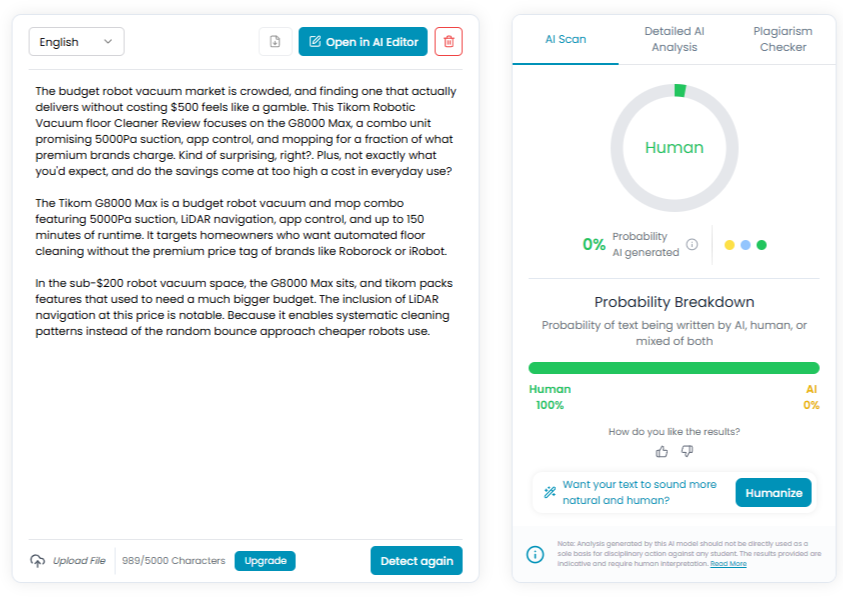
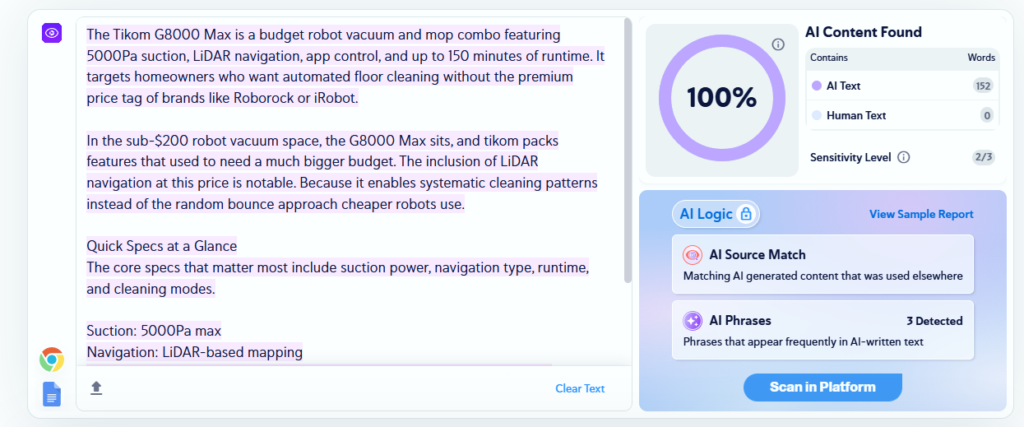
Run your draft through a detector and note exactly which sections get flagged. Don’t rewrite the whole thing. Most drafts only have a few problematic paragraphs, usually the introduction and any section with heavy transitions.
Copyleaks looks at the sentence-level breakdown if the tool offers one. Copy the flagged sentences into a separate document.
Here’s what usually gets flagged. Stats confirm it. The introduction, almost always. Transition sentences between sections.
Concluding paragraphs that summarize.
Naturally, any paragraph where every sentence is roughly the same length.
Which Sections Get Flagged Most Often (approx. %)
That’s your hit list. Work through it section by section, not top to bottom.
What’s the catch with detector scores?
Detector scores are inconsistent across apps. A 2025 study by Kar, Bansal, and Modi compared free AI detectors and found big variation in sensitivity, with some tools inaccurately flagging human content as AI-generated. That’s a major gap. Use scores as a guide, not a verdict.
Step 2: Rewrite the Introduction Manually
Delete your current introduction and rewrite it from scratch in your own voice. Don’t paraphrase the existing text. Start fresh, write the way you actually speak, and lead with a specific observation or question rather than a generic hook.
The introduction is where detectors look hardest, so AI-generated intros follow a predictable formula: broad opening statement; context, thesis sentence. Break that formula.
Start with a question, a number, a contradiction, and write something that a language model would be statistically unlikely to produce.
The same principle applies here. The more your text sounds like you 100%, not just “a human,” the harder it is for detectors to flag.
Step 3: Break Uniform Sentence Rhythm
Go through each flagged paragraph and deliberately vary sentence length. Break long sentences into two short ones. Combine two short sentences into one longer one. Change your sentence openings so you’re not starting every sentence with the same grammatical structure.
For now, this is the lowest-cost fix available, so no the stuff you need, no software, no budget, and just attention.
Now, AI text produces sentences of similar length, one after another, so that uniformity is a statistical fingerprint. It’s debatable.
A 2023 study by Krishna, Song, and Karpinska, cited 717 times, showed that paraphrasing alone can evade detectors. But the effect comes from changing structure, not just swapping words.
Try this: take any paragraph. Count the words in each sentence. If three consecutive sentences are within two words of each other in length, rewrite one of them.
Is varying sentence length really enough?
From a broader view, shifting gears a bit, it helps a lot, but it’s not a complete solution. Sentence variation addresses burstiness, one of two key signals detectors use. You also need to address perplexity by adding unpredictable word choices and precise details that a model wouldn’t generate.
Step 4: Add Specific Personal Details and Examples
Insert personal anecdotes, specific numbers from your own experience, opinions with reasoning, and concrete examples tied to your industry. Generic claims are one of the strongest signals that content feels machine-written, so replace vague statements with verifiable specifics.
You could say “The 12-person agency I worked with saw their organic traffic drop 40% after a core update,” but couldn’t. This detail matters more than it might seem right now.
In practical terms, add an exact number from your own work. Add an opinion with a reason. Add a name, a date, a place, a tool version. So add a mistake you made and what you learned from it.
This approach is defensible in a way that trick-based fixes aren’t, and you’re not gaming the detector. You’re making the content genuinely better, which is the whole point of learning how to bypass AI content detectors the right way.
Step 5: Recheck and Repeat the Cycle
Run your revised draft through the detector again. If specific sections still flag, repeat the rewrite cycle on those sections only. This detect, identify, rewrite, recheck workflow is the most defensible approach because it targets actual problems rather than applying blanket changes.
You probably won’t pick up everything in one pass. That’s normal. The first round catches the obvious patterns. The second round catches subtler ones.
Forum users, the majority without fail, report that style prompting alone isn’t enough, and that heavier manual editing is usually needed. Tool-based humanization is presented as rapid, which means but user comments suggest it may be inconsistent and still need heavy manual cleanup.
Skip the shortcuts. Run the cycle; it works.
- Run the draft through GPTZero or Originality.ai and screenshot the flagged sections.
- Rewrite flagged intros from scratch without referencing the original text.
- Vary sentence length by splitting long sentences and combining short ones.
- Add personal details like specific numbers, named tools, and real outcomes.
- Recheck the draft and repeat the cycle on any sections still flagged.
Troubleshooting
Three common problems come up when you fix AI-detected content: scores that won’t drop despite rewriting, over-edited text that reads worse than the original, and tools that give contradictory results. Score won’t drop after rewriting.
You’re probably paraphrasing rather than rewriting. Paraphrasing keeps the same structure and just swaps words. Delete the section and write it fresh.
Text reads awkwardly after editing. You’ve over-corrected. Too many fragments, too many stylistic quirks. Read it aloud; if you stumble, your reader will too.
Different detectors give different scores. The 2025 study by Kar et al. Found big variation across free detector tools. Pick one detector as your primary and stick with it.
Tempted to add deliberate typos? Don’t do it. It can reduce detector confidence, but it damages professionalism and readability. The trade-off isn’t worth it.
People Also Ask
Yes. The core fixes take zero time beyond a free detector for checking. You could say paid answers offer convenience but aren’t necessary for the actual editing work.
Expect 20 to 40 minutes for a thorough pass. Shorter if only the intro calls for work. Longer if multiple sections are flagged. Rushing leads to surface-level paraphrasing that doesn’t fool detectors.
They can produce rapid results, but community feedback suggests inconsistency, and a bunch of everyone reports needing heavy manual cleanup. After running text through a humanizer, they’re a starting point, not a finish line.
Then again, it might reduce detector confidence just barely. But it damages credibility and readability. Professional content should rarely ever rely on intentional errors. Focus on structural fixes instead.
What to Do Next After You Fix AI Detected Content
Once your content passes detection checks, build a workflow that prevents the problem from recurring. Write drafts with sentence variation from the start, add personal details during your first edit, and check flagged sections before publishing.
Up until recently, the best approach is prevention. If you use AI platforms to draft content, establish clear style guidelines that push for varied structure and specific examples from the start. That reduces the editing burden downstream.
If you’re scaling production, factor in how AI is changing content writing where human insight still matters most. The answer is usually in the details, the opinions, and the experiences that no model can fabricate.
For broader context on the trade-offs, the AI vs human content writing comparison makes the stakes clear. Your content is only as awesome as the person behind it, and fix the patterns; add the specifics creatives writing, and thoughts and make it yours.



